Quarterly OKR Review: Compare What You Committed With What Changed

In brief: A quarterly OKR review compares the Objectives and Key Results (OKRs) agreed at the beginning of the quarter with the outcomes at the end. Capturing an OKR baseline makes changes to targets, ownership, time periods and scope visible, helping teams score outcomes accurately and make informed carry-over decisions. This ensures that achieving a revised target is not mistaken for achieving the original goal.
Every quarterly OKR review should answer two questions:
a) What did we achieve?
b) And what changed along the way?
OKRs are live by design. Owners change, targets move, dates slip, and Objectives are added or removed. Those can all be sensible decisions. But when the quarter-end review shows only the latest version, teams may be scoring a plan that is no longer the one they originally agreed to.
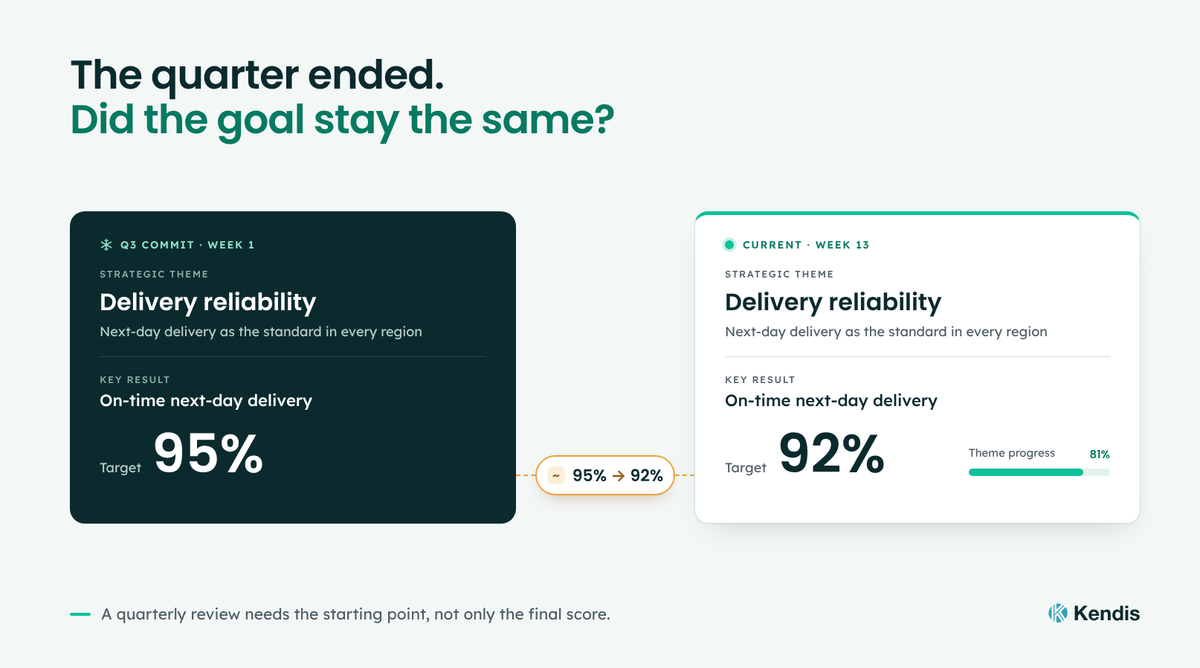
A parcel delivery company starts Q3 with an ambitious Key Result: raise on-time next-day delivery from 82% to 95%. By quarter-end, the Strategic Theme shows 81% progress. The delivery rate is 92%, the revised target is also 92%, and the Key Result is green.
The COO asks: “Did we hit 95%?” The answer is no, even though the revised target was achieved.
The current OKR tells you where the quarter ended. A useful quarterly OKR review also needs to show where it started.
What is a quarterly OKR review?
A quarterly OKR review is an end-of-cycle assessment of what happened to the Objectives and Key Results agreed for the quarter. It evaluates outcomes, explains important changes, identifies unfinished commitments and turns the evidence into decisions for the next cycle.
A useful review brings three views together:
- Baseline: what the organization agreed at the start.
- Current state: where the OKRs ended.
- Change: what moved between those two points, and why.
Without the first view, a review can score the current OKRs accurately while still giving an incomplete account of the quarter.
The hidden problem with live OKRs
At the start of Q3, the parcel-delivery company agrees on one Strategic Theme: Delivery reliability: next-day delivery as the standard in every region.
The theme is organized into Objective Groups, with Objectives describing the outcomes each area owns and Key Results measuring those outcomes. Customer Experience and Regional Operations have the initial Objectives; Network Planning, another Agile Release Train (ART), joins the theme as a new need emerges.
Each Key Result has a responsible person, a time period and a measurement. The Regional Operations Objectives are tracked by the South and East hub leads, while the North hub expansion contributes to network-wide capacity.
Six OKR change events in thirteen weeks
- Week 3: A storm closes a hub for two days. Network Planning adds the Objective “Reroute parcels automatically around hub delays” and a supporting Key Result.
- Week 5: The live parcel tracking Key Result changes owner, from A. Novak to R. Silva.
- Week 7: The North sorting hub opening slips from Q3 to Q4.
- Week 9: A carrier contract falls through. The on-time delivery target is lowered from 95% to 92%.
- Week 10: The delivery-window notification Key Result is removed and its work is merged into live tracking.
- Week 11: Two Regional Operations Objectives, covering the South and East hub contributions, move from On Track to At Risk.
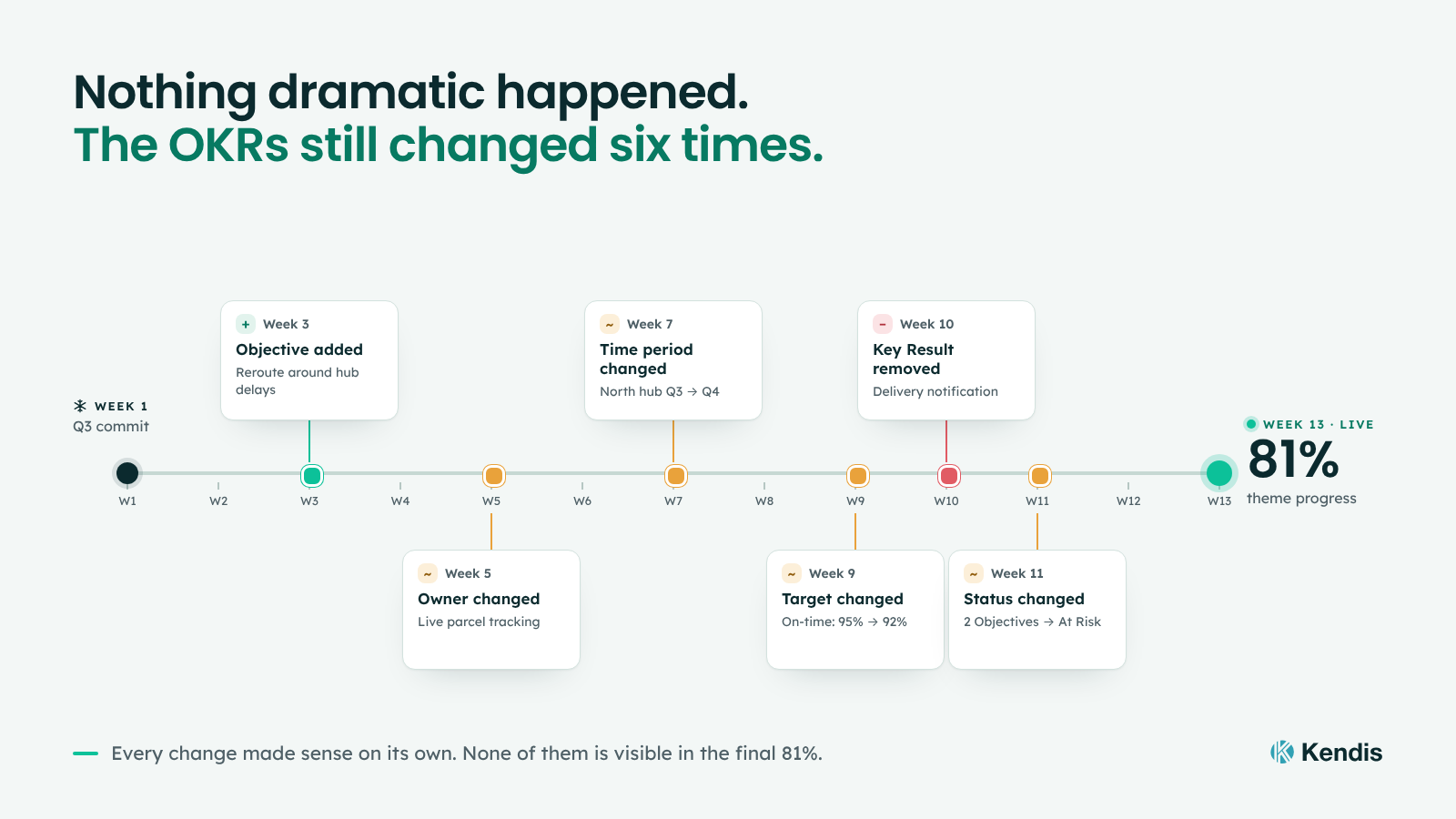
None of these changes is automatically wrong. Adaptive planning should respond to new information. The problem is losing the ability to see how the plan changed.
At quarter-end, the 81% theme progress describes the current state. It does not, by itself, explain which parts of the plan were agreed in July and which were changed in August or September.
What is an OKR baseline?
An OKR baseline is a point-in-time record of the Objectives and Key Results agreed at the beginning of a cycle. It gives the quarter-end review a stable reference for comparing the original plan with actual results and subsequent changes.
A useful baseline preserves:
- The Objective Groups, Objectives and Key Results in scope.
- Responsible people, teams and time periods.
- Measurement methods, starting values and targets.
- Status and progress at the time of capture.
- Reporting scope, including relevant filters and time range.
An OKR snapshot is a read-only record of that state at a selected moment. The baseline is the snapshot chosen as the reference for comparison. In this article, a commitment baseline means the version agreed at the beginning of the cycle; it does not mean that every OKR is a committed rather than an aspirational goal.
Freeze the commitment, not the work.
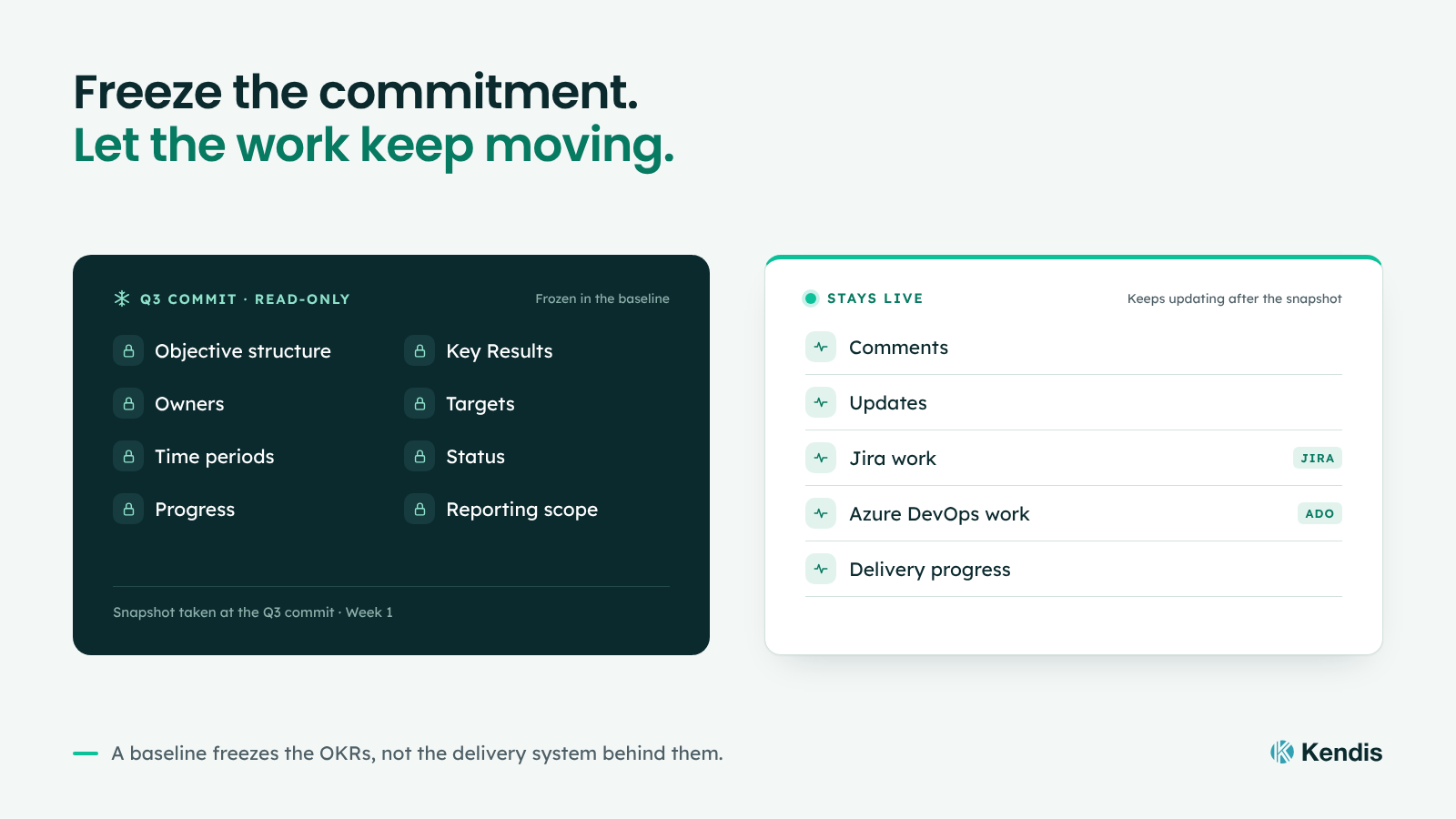
Comments, updates and delivery work in Jira or Azure DevOps continue to move. The baseline preserves the earlier strategic state without creating a second delivery system.
Should OKRs change during the quarter?
Yes. A target may need to change because an assumption proved wrong. A responsible person may change because ownership moved. A date may slip because an external dependency did not land, or a new Objective may be added in response to a risk.
The important question is whether the changes can be explained clearly enough for the final score to retain its meaning. A baseline comparison should distinguish four states:
For modified items, retain the previous and current values. A renamed Objective should still be recognized as the same Objective, rather than appearing as a false deletion and addition.
How to run a quarterly OKR review with a baseline
Before the meeting: capture the baseline at the start of the cycle. At quarter-end, compare it with the live OKRs, review the changes, score the outcomes, separate justified adaptation from missed commitments, and agree what carries over.
Step 0. Capture the baseline when OKRs are agreed
Save the approved version of the OKRs, including their targets, owners, status and reporting scope. Make sure the capture is complete. In the parcel example, this is the Q3 commit snapshot.
1. Review what changed
Start with the changes that altered the meaning of the final percentage. Compare the start-of-cycle baseline with the current OKRs and review the six business events, including the added rerouting Objective, the new tracking owner, the delayed hub, the revised delivery target, the removed notification Key Result and the two deteriorating Objective statuses.
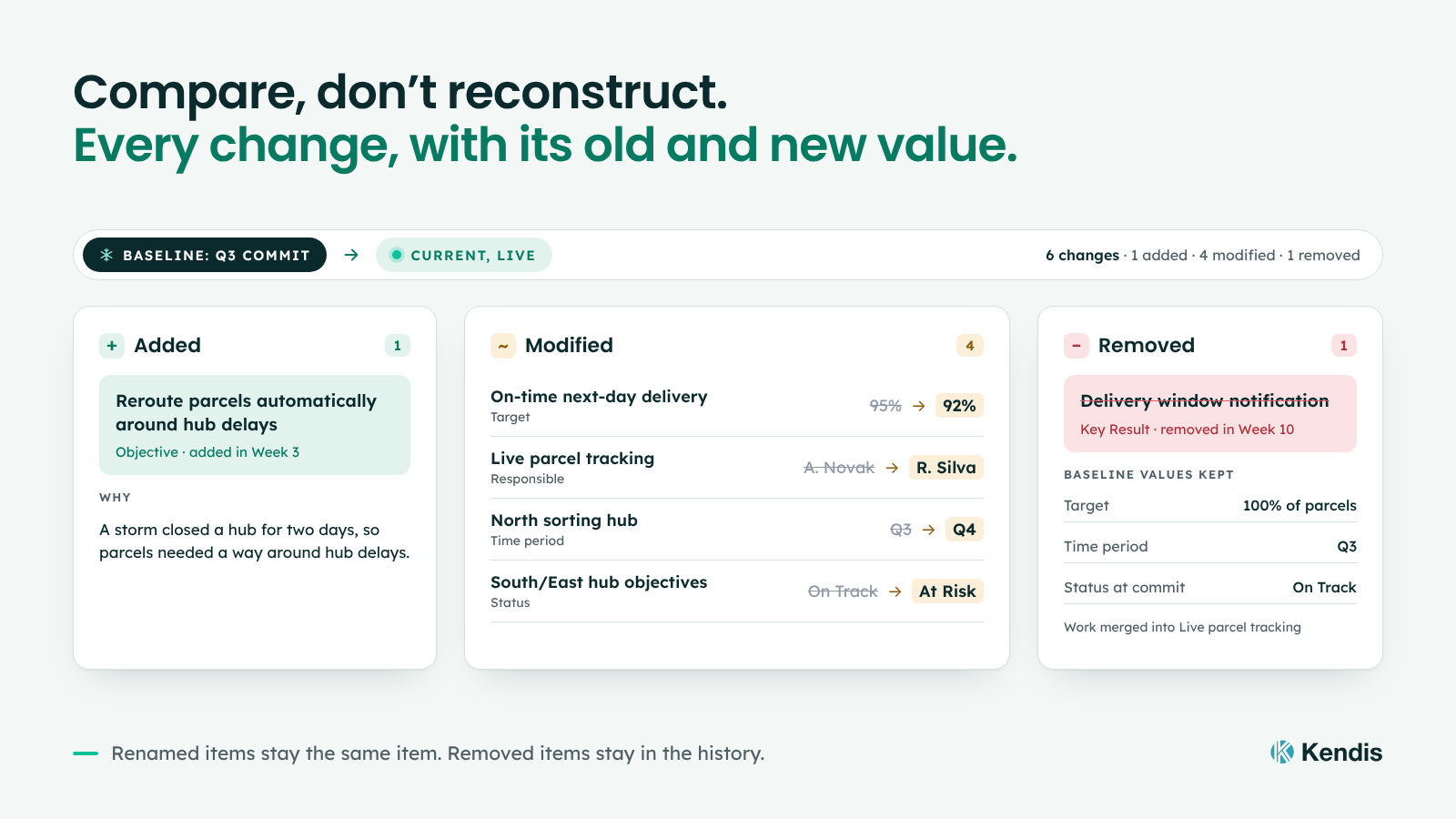
The six events are grouped for discussion. A software comparison can count more individual items because a new Objective may introduce a Key Result and one status decision may affect two Objectives. Here those six events account for eight changed items: two added, five modified and one removed.
Now the COO’s question can be answered in one sentence: No, we did not reach 95%. We lowered the target to 92% after the carrier contract fell through, and we reached the revised target.
The number has not changed. The quality of the explanation has.
2. Score the outcome against the right target
Quarter-end scoring only works when everyone knows which target is being scored. In the delivery example, the starting value was 82%, the original target was 95%, the revised target was 92%, and the actual result was 92%.
This example measures improvement from the starting value, rather than dividing the final rate by the target. Your scoring method may differ, but keep the original target, revised target and actual outcome visible. For more on measurement and scoring methods, see the Kendis OKR Guide.
The distinction also matters for committed and aspirational OKRs. A committed OKR generally carries an expectation of full achievement, while an aspirational OKR may deliberately stretch beyond what is expected in the cycle. A lower revised target should not erase the original level of ambition or the scoring expectations agreed at the start.
3. Separate change from failure
A comparison is not a list of mistakes. Giving an unassigned Key Result an owner or moving a delivery date earlier can be positive. Other changes, such as a reduced target, a later date or deteriorating status, deserve discussion. The purpose is to understand the decision and its effect, not to punish adaptation.
Changing the plan is agile. Hiding the change is not.
4. Decide what carries over
Unfinished commitments need an explicit decision. Close work that has been completed, carry over work that still matters, rewrite a goal if its outcome or approach changed, or drop it if it is no longer valuable. For each item carried forward, agree the owner, reason and next time period.
In the delivery example, the North hub has already moved to Q4. It is a known future commitment, not evidence that the Q3 deadline was met. Make that distinction visible even if the current Q3 report no longer includes the item as a carry-over candidate.
A sample 60-minute quarterly OKR review agenda
Ask owners to update their outcomes and review the baseline comparison before the meeting. Use the meeting for decisions rather than data collection.
OKR review vs. OKR retrospective vs. check-in
These three conversations are related, but answer different questions. A check-in focuses on progress now. The quarterly review establishes the outcome and what changed. The retrospective uses that evidence to improve how the organization runs its OKRs.
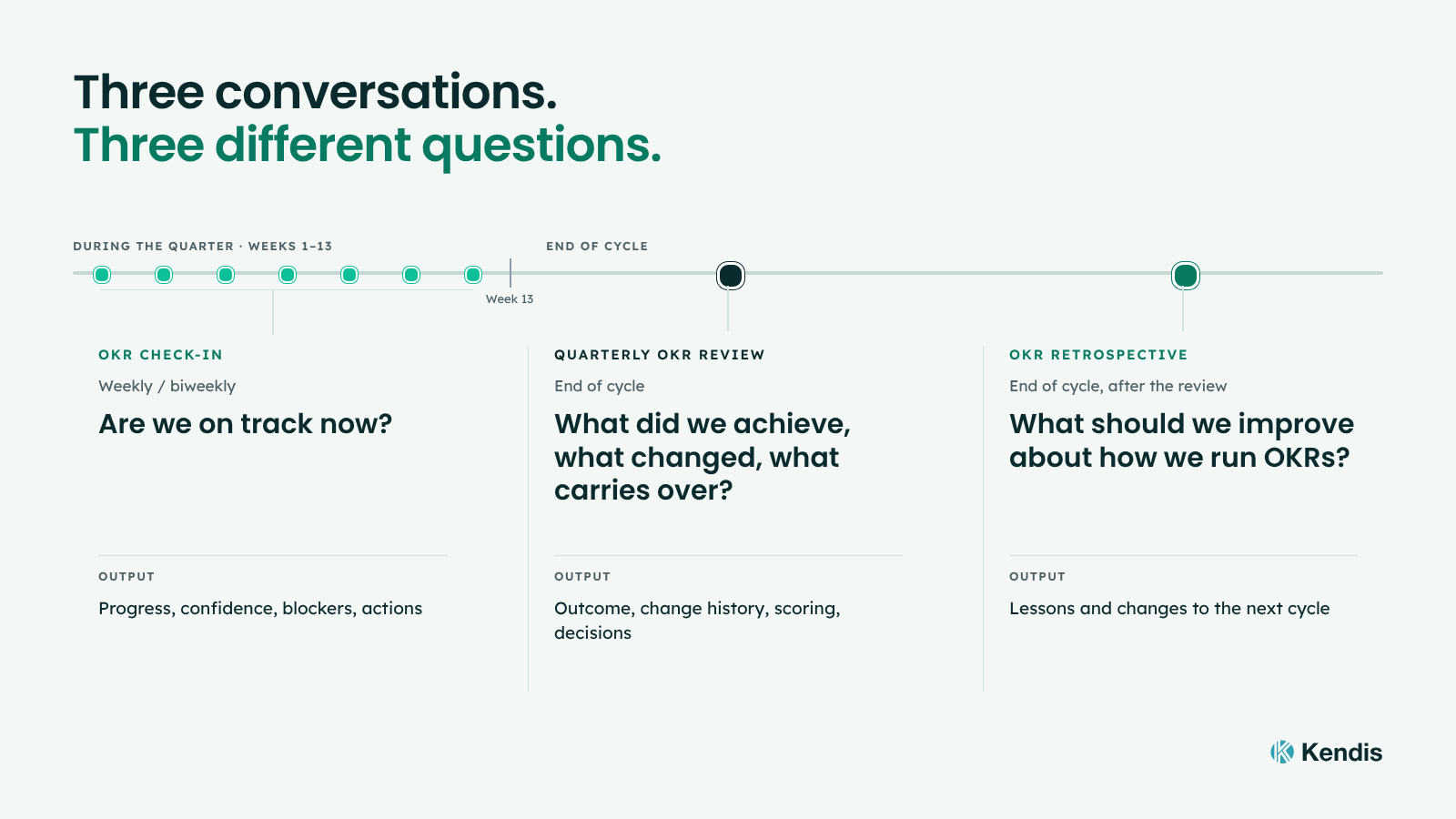
The strongest quarter-end rhythm does both: first establish the evidence, then discuss what the organization learned from it.
From OKR change history to a QBR scorecard
A Quarterly Business Review (QBR) can cover a much broader business agenda than OKRs alone. An OKR scorecard gives its strategy and execution discussion a useful foundation: attainment, ownership, change history, carry-over and the major wins and misses.
Kendis uses separate reporting measures for Key Result attainment, Objective grades and performance by responsible person or team. The attainment bands are 90% or more (met), 70% to under 90% (close), 40% to under 70% (partial), and under 40% (missed). Objectives receive corresponding grades A, B, C or D.
The Kendis performance verdicts use average progress and movement since the selected baseline:
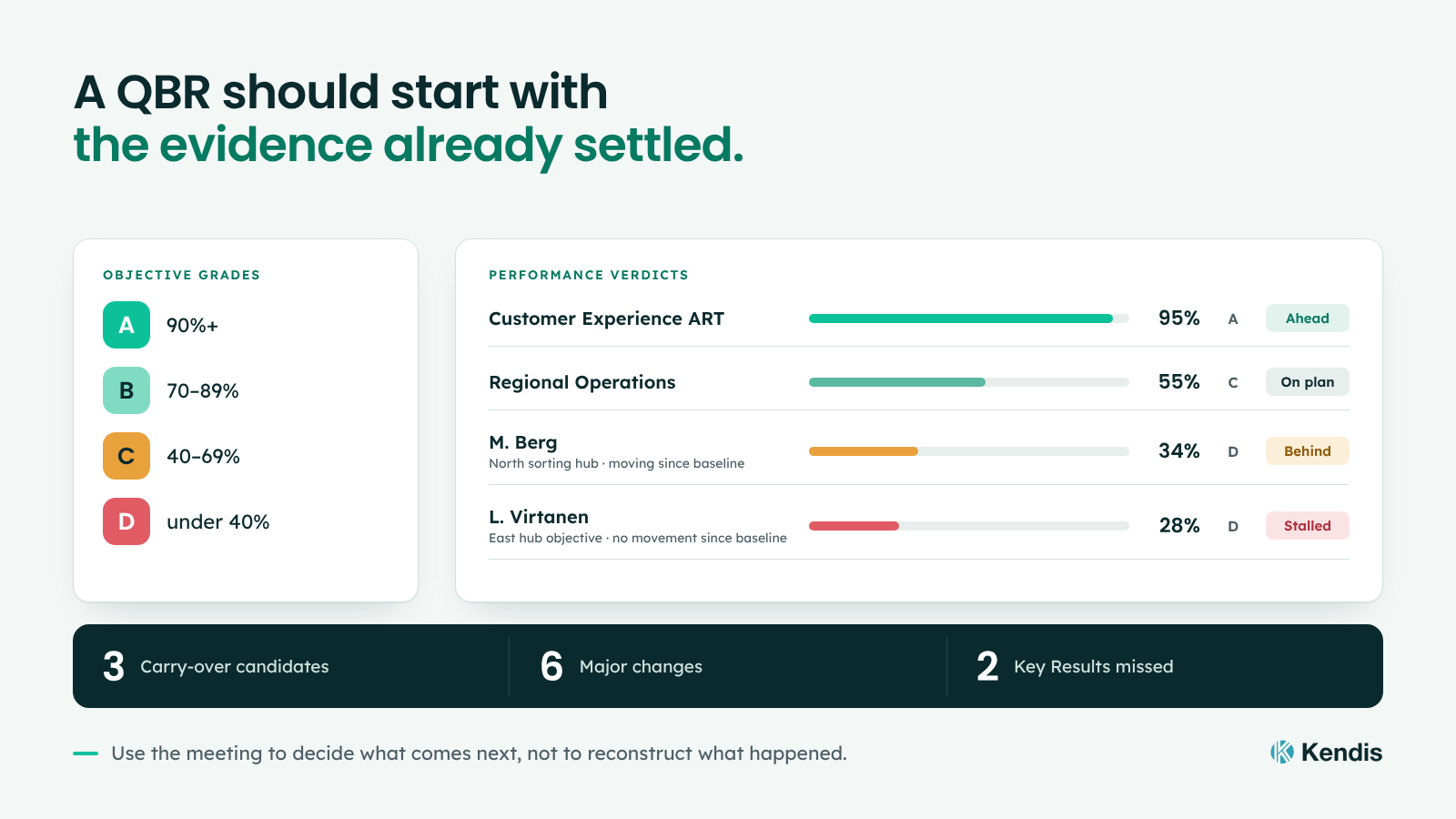
In the illustrative scorecard, Customer Experience ART has 95% average attainment, distinct from the original 95% on-time delivery target. The letters illustrate attainment bands. In Kendis, grades apply to Objectives and verdicts to people and teams.
The North sorting hub owner, M. Berg, is at 34% and has made progress since the baseline, so the verdict is Behind. L. Virtanen, at 28% with no gain, is Stalled. Those situations call for different conversations: how to help finish work that is moving, and what is preventing work from moving at all.
Use carry-over candidates as a review input, not an automatic commitment to repeat the same work. The Kendis QBR identifies incomplete Objectives and Key Results whose end period is in or before the reporting period.
A simple quarterly OKR review cadence
A closing snapshot preserves where the quarter ended, but cannot recover the original commitment if it was never captured. Three checkpoints give the cycle a useful shape:
- Commit (week 1): Take a baseline once the quarter’s OKRs are agreed. Example: Q3 commit.
- Mid-point (week 7): Compare the baseline with current OKRs and act on emerging changes. In the example, the rerouting Objective, owner change and North hub delay are already visible. Capture Q3 mid-point review.
- Close (week 13): Save Q3 close and run the quarter-end review against the original baseline while the live theme still reflects the closing state.
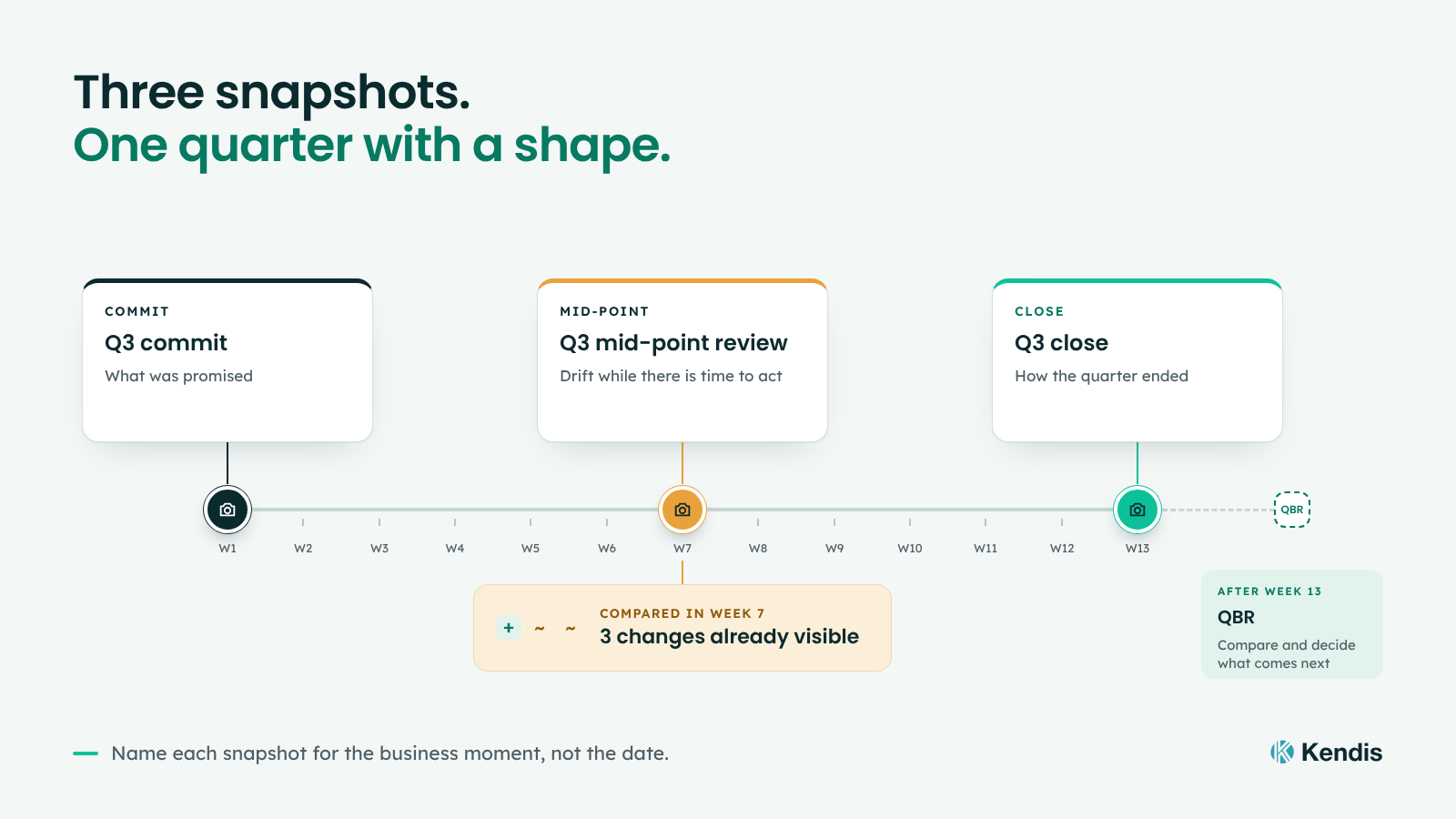
Keep the reporting scope consistent and name each snapshot for the business moment. Kendis records the timestamp automatically. A saved closing snapshot remains a historical reference even as the live theme moves into the next cycle.
OKR Snapshots in Kendis
In Kendis, OKR Snapshots are part of Strategic Themes. They preserve the Objective structure, ownership, time periods, measurement fields, status and progress while the live Strategic Theme and its linked Jira, Azure DevOps or Kendis work continue to evolve.
For context on connecting strategic outcomes to delivery, read Strategic Themes in SAFe: How to Connect OKRs, PI Objectives and Delivery.
Select a saved snapshot as the baseline and compare it with the current live theme. Kendis uses the captured reporting scope, groups changes by Objective Group and identifies Added, Modified, Removed and No change items, including old and new values for modified fields.
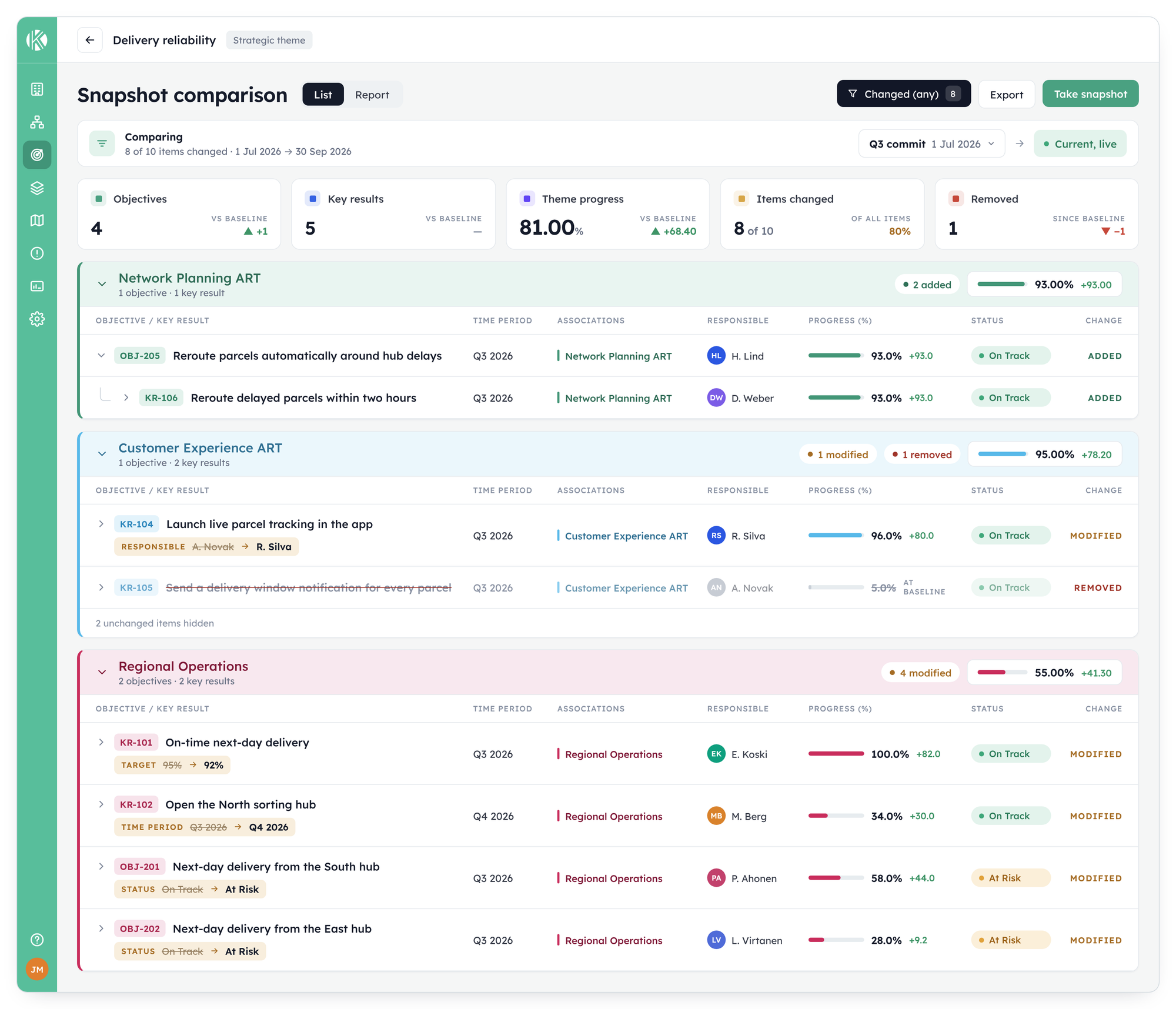
The product example shows the eight changed items behind the six grouped events, including the new Objective and its Key Result. The 81% theme progress is the current aggregate, not a score against the original on-time delivery target.
The same data can feed two report views:
- Comparison report: change counts, changes by Objective Group, status mix, ownership shifts, biggest progress movements and a detailed change log.
- QBR: Objective scorecard, Key Result attainment distribution, performance by responsible person and team, carry-over, highlights and misses. The QBR can also be run without a baseline, but the baseline makes change and movement visible.
A comparison can be shared through its page address. Portfolio snapshots are also available as read-only records, while comparison and QBR reporting are available for Strategic Themes. For the product workflow, see the OKR Snapshots guide.
The quarterly review should not have to remember the quarter
Every quarter ends with a question like the COO’s: did we deliver what we agreed to? Sometimes the answer is yes. Often the more useful answer is “not exactly, and here is what changed.”
OKRs should adapt as teams learn. But adaptation should leave enough evidence to distinguish a genuine outcome from a target that moved, a date that slipped or work that was removed.
A quarterly OKR review should start with the story already visible, not spend the meeting reconstructing it.
Frequently asked questions about quarterly OKR reviews
What should an OKR baseline include?
An OKR baseline should preserve the Objectives and Key Results agreed at the start of the cycle, along with owners, measurement methods, targets, time periods, status, progress and reporting scope. Keep it read-only so it remains a reliable reference while the live OKRs continue to change.
How do you score OKRs at quarter-end?
Use the scoring method agreed when the OKRs were set. Some teams use 0.0–1.0, percentages or attainment grades. Where a target changes, show the original target, revised target and actual outcome separately. When appropriate, calculate attainment against both targets using the same measurement method.
Should OKRs be changed during the quarter?
Yes, if new information justifies it. Owners, targets, dates and even Objectives can change. Record the reason and preserve the original version so the quarter-end review can distinguish a justified adaptation from a missed commitment.
What is the difference between an OKR review and an OKR retrospective?
An OKR review evaluates outcomes, changes and carry-over decisions. An OKR retrospective examines how the team sets, tracks and works with OKRs, and what should improve in the next cycle. The review establishes the evidence; the retrospective uses it to improve the process.
How often should OKRs be reviewed?
A practical cadence is weekly or biweekly check-ins, a mid-cycle review and a quarterly review. Capture snapshots when the cycle starts, at the mid-point and when it closes, so significant changes can be seen early and the final outcome can be compared with the original baseline.
What happens to unfinished OKRs at quarter-end?
Give each unfinished OKR an explicit decision: close it if complete, carry it over if still valuable, rewrite it if the outcome or approach has changed, or drop it if it no longer matters. Record the reason, owner and new timing for carried-over work.
Do you need OKR software to keep a baseline?
No. A small team can save a read-only spreadsheet or document when OKRs are agreed. Software is useful when Objectives span many teams, owners and delivery tools, because it can compare versions, reveal changes and generate reports without manually reconstructing the quarter.