From Portfolio Kanban to Team Kanban: Connecting Strategy, Product and Delivery
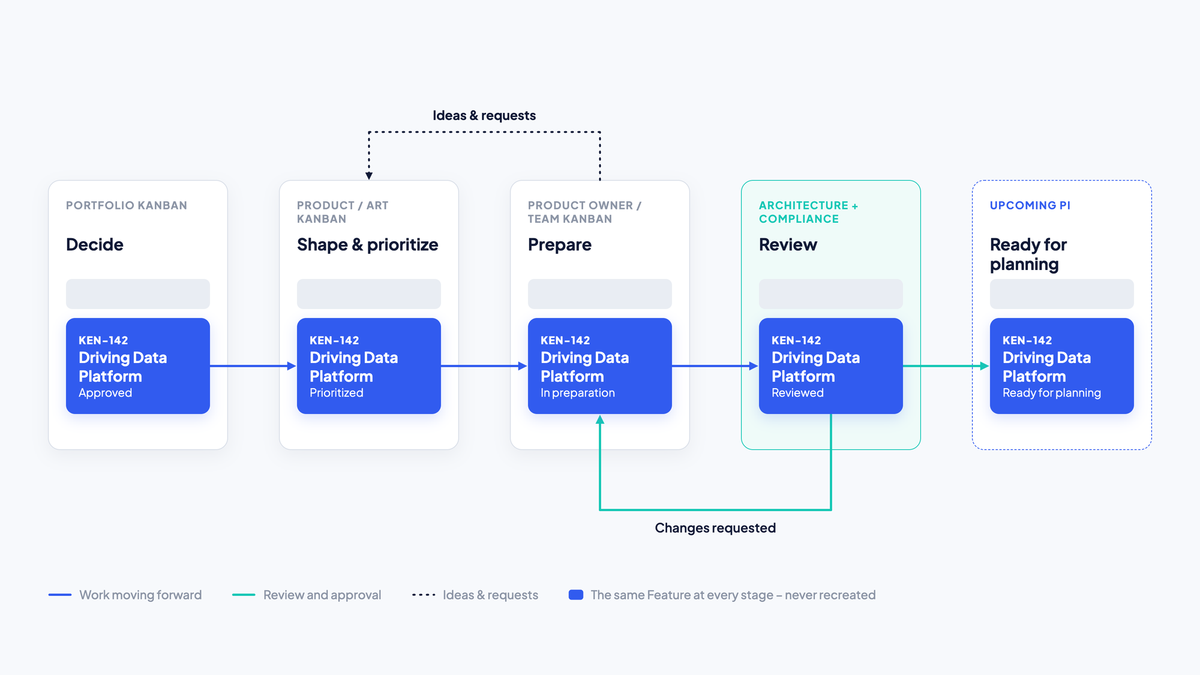
Large organizations rarely have one Kanban. Portfolio, Product Management, Architecture and delivery each need their own flow. The challenge is keeping the same work connected as it moves between them.
Kanban works well when you can see work moving through a process. But enterprise planning rarely happens inside one process or on one board.
Portfolio may use a Kanban to evaluate strategic initiatives and investment decisions. Product Management may use another flow to shape and prioritize Features. Product Owners and teams prepare work at a more detailed level, while Architecture, Compliance and other functions may have their own review processes.
In SAFe environments, these may appear as Portfolio Kanban, ART Kanban and Team Kanban. The names can vary, but the challenge is the same.
The challenge begins where one Kanban ends and another needs to start.
The answer is not to put everyone on one giant board. It is to connect the points where responsibility changes, so the same work can continue through different workflows without being recreated at every handoff.
That is the idea behind connected Kanban. In Kendis, Kanban Routes connect separate boards so work can move forward, return for review, travel upward for a decision, or continue into planning while each group keeps the workflow that fits its responsibilities.
Follow one Feature from strategy to delivery preparation
Consider a new usage-based car insurance product that has just been approved.
The investment decision is made. The target quarter is known. Portfolio has done its part.
But approval does not mean the work is ready for delivery.
Product Management still needs to turn the initiative into actionable Features. Product Owners need to refine those Features. Architecture needs to review the solution. Because the product uses customer driving data, Compliance needs to be involved. Delivery teams eventually need work that is clear enough to plan and execute.
None of those responsibilities should disappear. The problem is maintaining continuity as the work moves from one responsibility to the next.
Portfolio approval is where the next flow begins
The initiative moves through Portfolio Kanban until the investment decision is made.
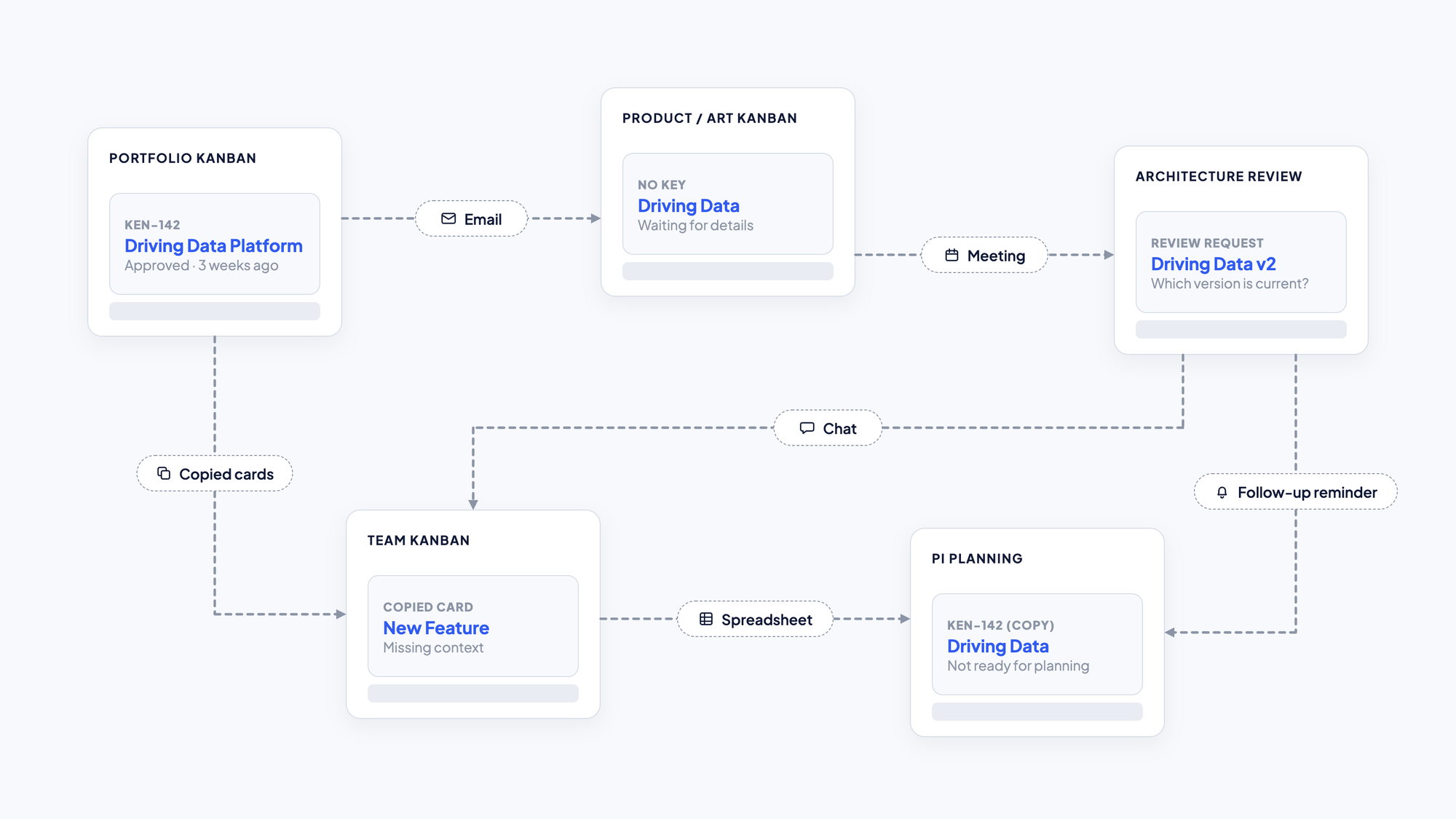
In a disconnected process, approval often creates a new task for somebody: tell Product Management, copy the item to another board, schedule a meeting, send a message, or remember to follow up.
The decision has been made, but the work pauses while the organization performs the handoff.
With a connected flow, reaching the agreed Portfolio stage can move the same work into Product Management's view.
Approval becomes the beginning of the next step, not the end of the previous process.
Product Management turns strategy into work teams can prepare
Once the initiative reaches Product Management, it needs to become something delivery teams can eventually work with.
For the usage-based insurance product, one Feature might be a platform for collecting driving data from customers' cars.
Product Management shapes the Feature, evaluates its priority and decides which part of the organization should take it forward.
At some point the question changes from "Should we invest in this?" to "Is this mature enough for a Product Owner and delivery area to start preparing it?"
That transition can become part of the flow. The Feature appears in the relevant working view without somebody having to recreate it simply because responsibility has moved.
Different levels need different Kanban flows
Connected Kanban does not require every group to adopt the same columns, rules or workflow.
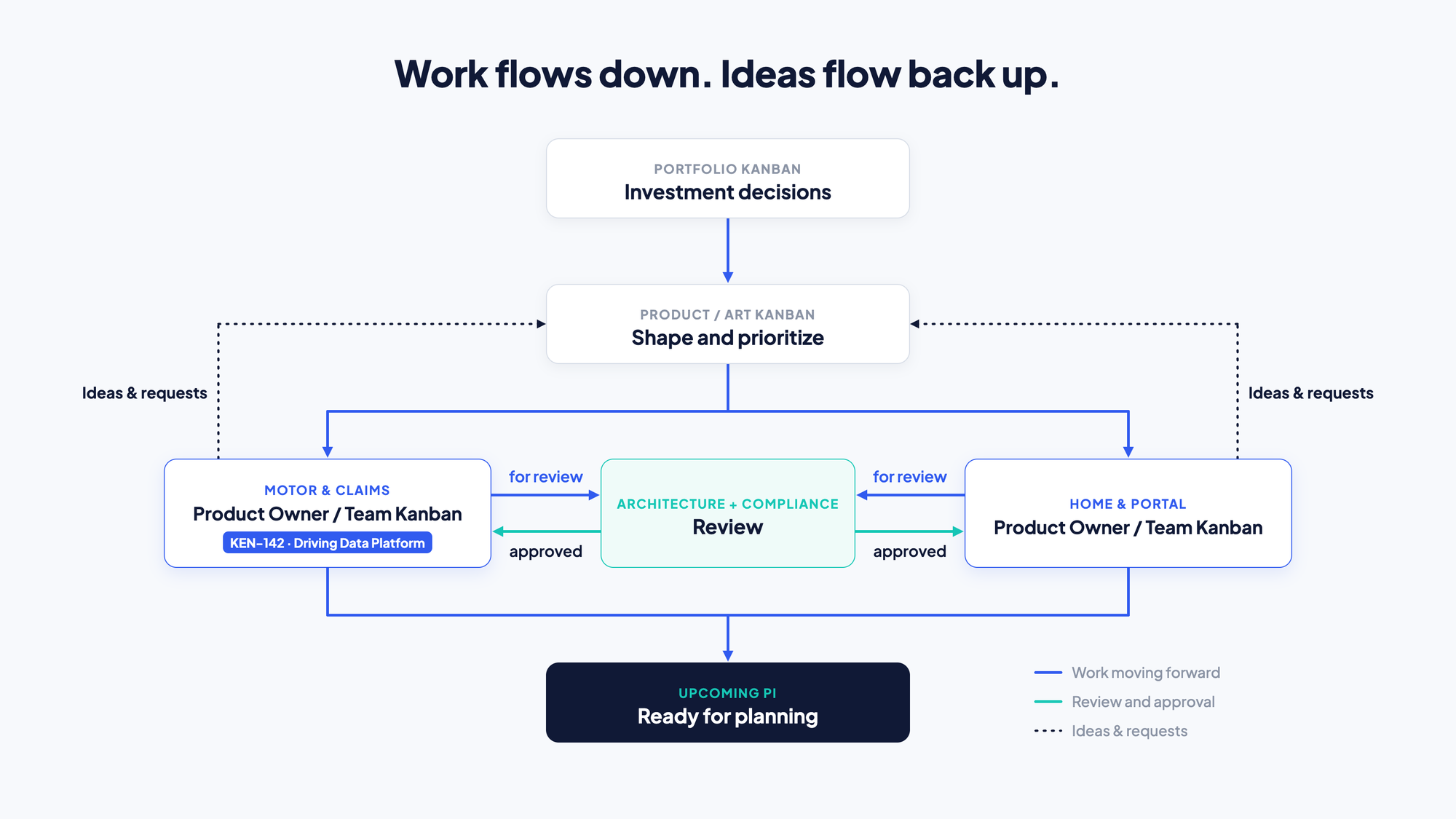
Portfolio can keep the stages it needs for investment decisions. Product Management can use a flow for shaping and prioritizing Features. Product Owners can prepare work in the way that makes sense for their teams. Architecture and Compliance can keep their own review process.
The goal is not to standardize every board. It is to connect the points where responsibility changes.
That distinction matters. A large organization does not need one universal Kanban. It needs continuity between the Kanban systems that already serve different purposes.
Real work includes review loops
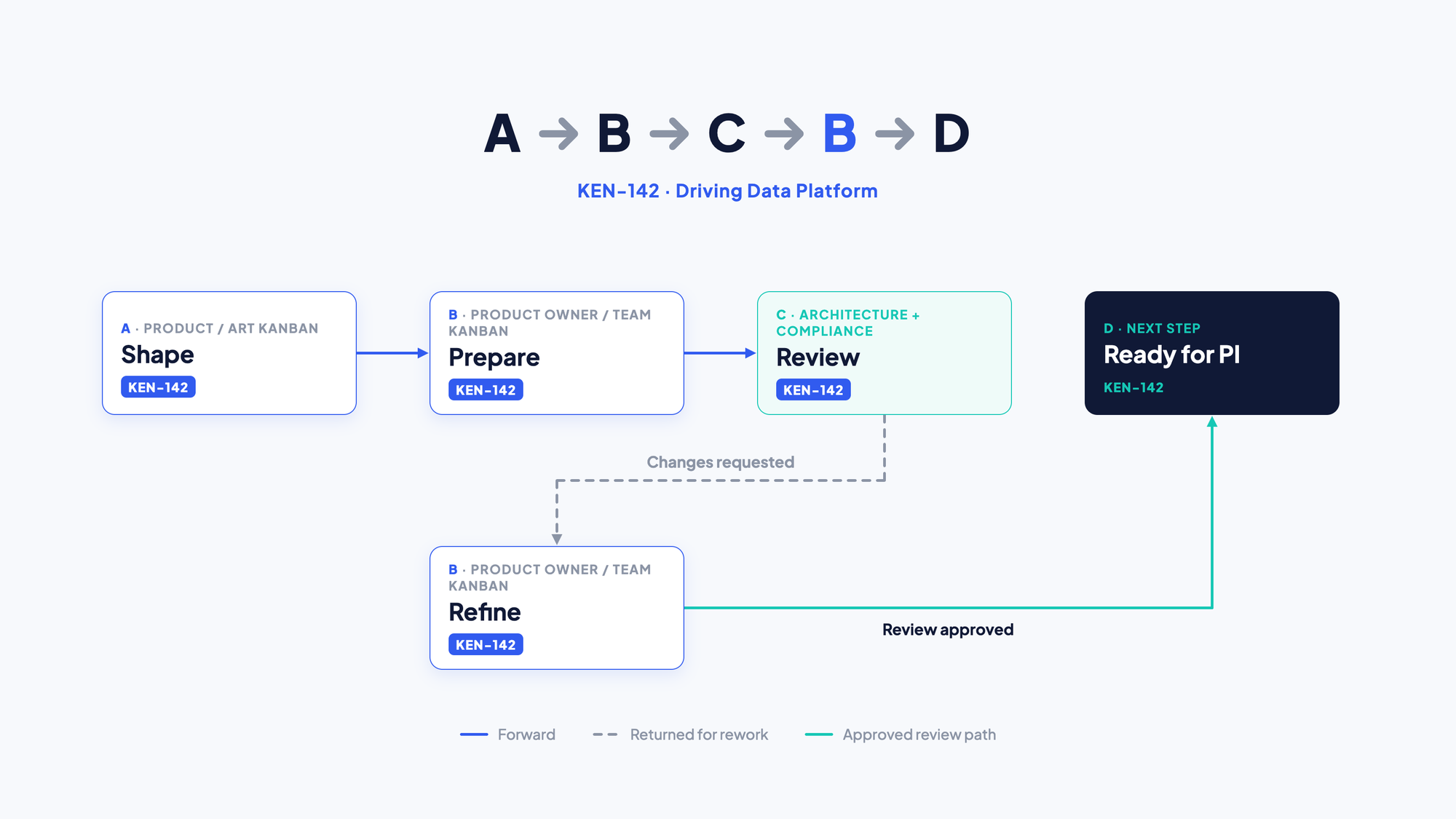
Simple workflow diagrams often show A -> B -> C -> D.
Real organizational work often looks more like A -> B -> C -> B -> D.
The driving-data Feature is a good example. The Product Owner can begin preparing it, but Architecture and Compliance need to review the solution before detailed refinement continues.
Technical feasibility may need to be assessed. Privacy and data concerns may need to be checked. Changes may be requested.
If something needs to change, the Feature returns to the Product Owner. Once the review is complete, it can continue forward again.
That return path matters. Organizational processes contain review loops, rework, approvals and exceptions. A connected flow should represent that reality instead of pretending everything only moves forward.
Good ideas can travel upward too
The flow is not only top-down.
Teams are often the first to hear what customers need. A Product Owner may discover that customers want to report home damage online and attach photos.
That idea starts close to the customer, but it may need Product Management to decide whether it deserves broader investment.
With Kanban Routes, the Product Owner can raise the work into Product Management's intake instead of relying on a separate email, spreadsheet or backlog that may never be reviewed.
The same principle can support ideas, feedback, escalations, requests and decisions that need to move to another organizational level.
Work can move down. Ideas can move up. Reviews can move sideways and back again.
Stopping work is part of good flow
Connected flow should also make it clear when work should not advance. Suppose Product Management receives another proposal for a cyber insurance offering aimed at small businesses. After review, the decision is that it does not fit the current strategy. It is parked.
That is also a useful outcome.
Good flow management is not about pushing every item toward delivery. It is about making the state of work visible, including:
- What is progressing
- What is waiting
- What needs more work
- What has been rejected
- What may be reconsidered later
The work remains visible and the decision remains traceable instead of disappearing into somebody's inbox or spreadsheet.
From connected flow to planning-ready work
Once the necessary reviews are complete, the Product Owner continues preparing the Feature.
Business intent becomes clearer. Technical questions are resolved. The solution takes shape. Stories and delivery details can be prepared.
The important point is not the exact number of refinement stages. It is that readiness develops progressively.
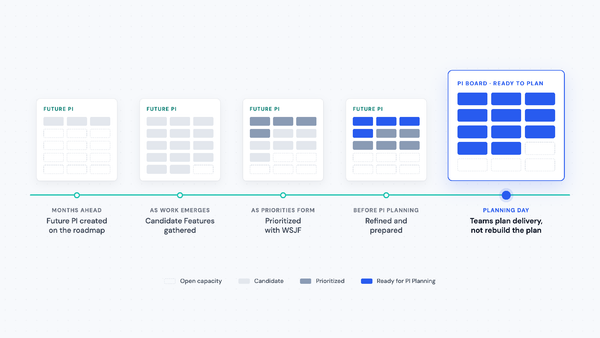
When the Feature is genuinely ready for the upcoming PI, it can move into that PI and onto the PI Board. Work that is not ready does not have to be forced into the plan.
By the time teams reach PI Planning, the Feature has already passed through the parts of the organization that needed to contribute to it.
PI Planning can then focus on planning the work rather than discovering all the preparation that should have happened beforehand.
This is where Portfolio Kanban, Product or ART Kanban and Team Kanban stop looking like separate islands. They remain distinct flows, but the work can continue between them.
See the connections as one system
Once several boards are connected, another perspective becomes valuable: seeing the flow itself.
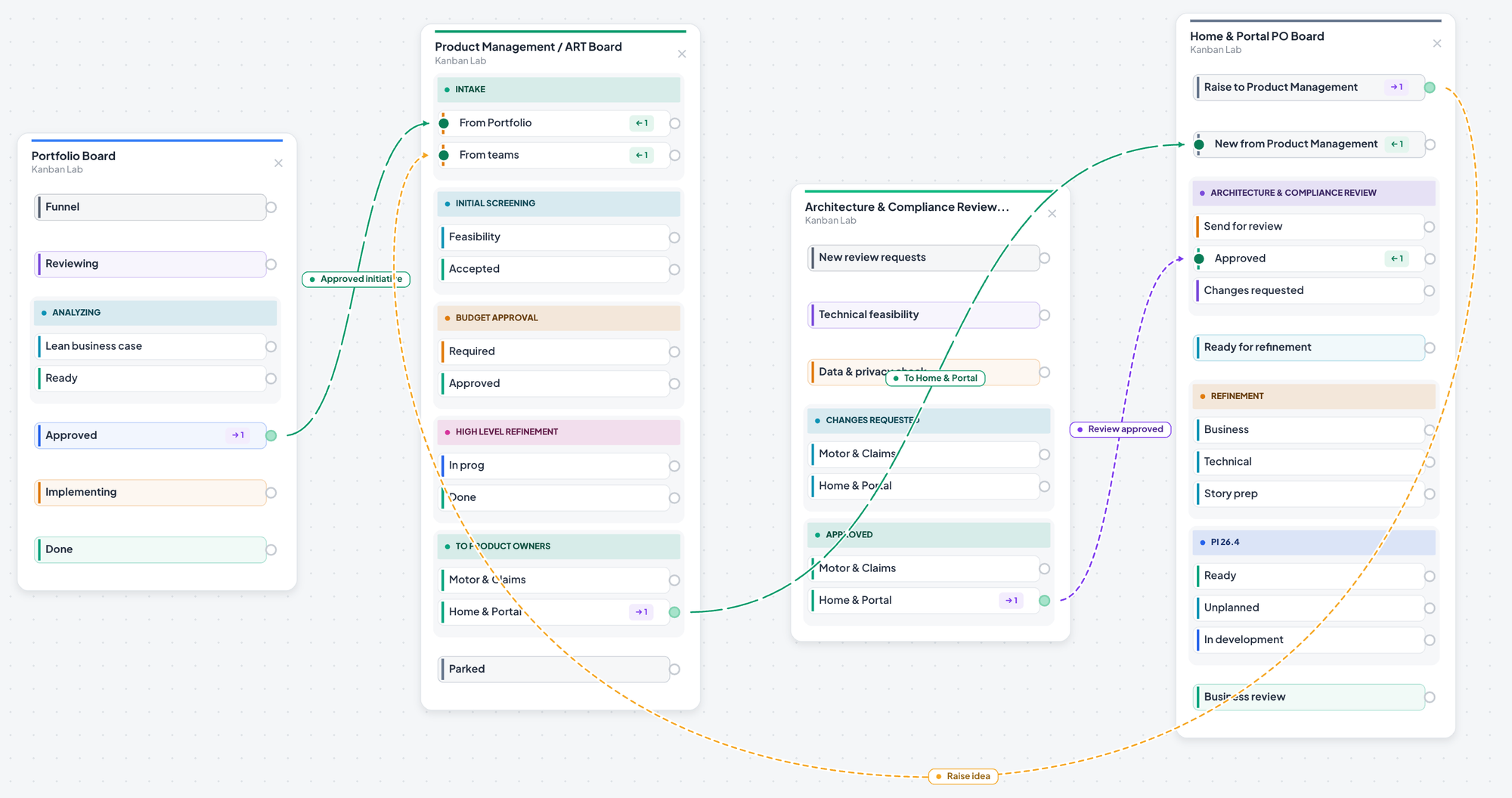
The Kendis Kanban Route Designer brings those relationships together so you can see which boards participate, where work moves next, where reviews happen and where return paths exist.
That makes it more than a configuration view. It becomes a visual model of how work moves across organizational boundaries.
Portfolio can see where approved work goes. Product Management can see the delivery areas it feeds. Teams can see where they need input from Architecture or another function. Everyone can understand how work eventually reaches planning.
Kendis also provides Kanban templates for common purposes, including Portfolio, Product Management, SAFe / ART, Team Delivery and connected flows. They provide a starting point that can be adapted to the way each organization already works.
Connect the flows, not just the boards
Portfolio still decides. Product Management still shapes. Architecture and Compliance still review. Product Owners still refine. Teams still plan and deliver.
Those responsibilities do not need to change. What changes is how the work moves between them.
The same Feature can continue through the organization without relying on someone to remember the next email, copy an item into another board or chase another group for an update.
The responsibility changes. The work does not need to be recreated.
The real value is not another board. It is continuity between the boards.