Strategic Themes in SAFe: How to Connect OKRs, PI Objectives and Delivery
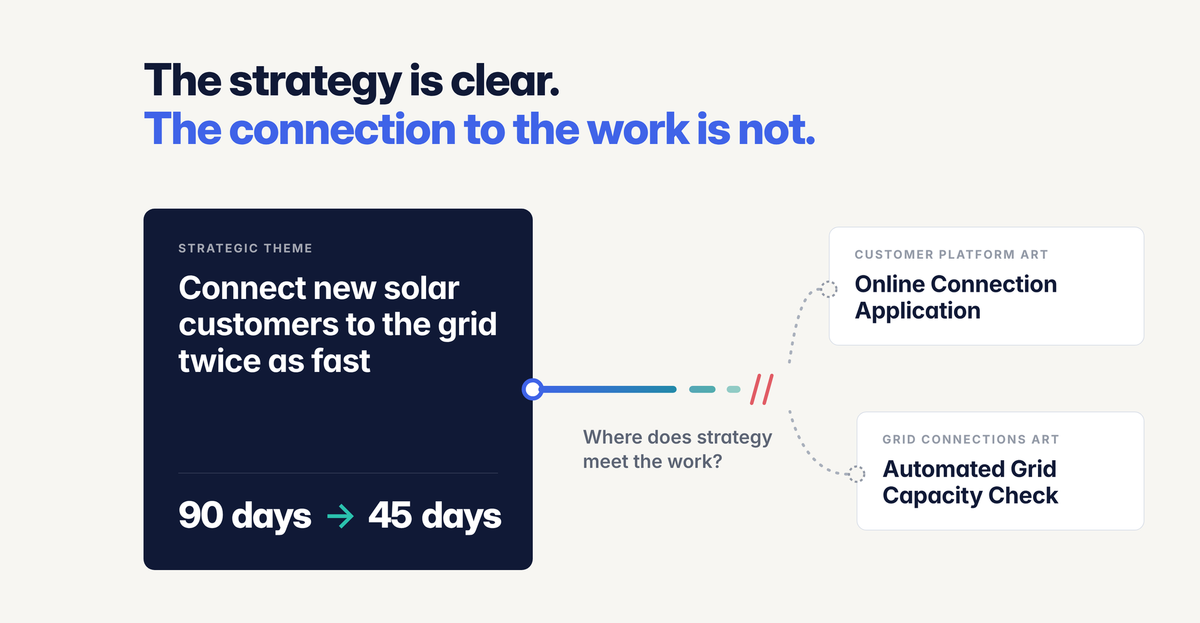
Every portfolio has a strategy slide.
It is usually agreed at a leadership offsite: a handful of Strategic Themes, each expressed as an objective with measurable Key Results. Everyone agrees with the direction. The slide goes into the portfolio folder, and the next PI begins.
A few weeks later, someone asks a simple question:
Which work is actually moving this Strategic Theme?
The answer is rarely in one place. Strategic Themes may live in a presentation. OKRs may live in a spreadsheet. Epics and Features live in Jira or Azure DevOps. PI Objectives live with the ARTs. Progress is reconstructed before the next review.
For a week, the picture is accurate.
Then delivery changes.
That is the real strategy-to-execution gap: not defining strategy, but keeping a visible, measurable connection between the strategy and the work intended to deliver it.
What are Strategic Themes in SAFe?
Strategic Themes in SAFe are portfolio-level business objectives that connect enterprise strategy to a SAFe portfolio. They give ARTs and teams business context for decisions and help keep portfolio investments, backlogs and delivery aligned with measurable outcomes.
Current SAFe guidance says Strategic Themes are best stated in Objective and Key Result (OKR) format. The objective describes the change the portfolio wants to create. The Key Results provide measurable evidence that the change is happening.
Strategic Themes are a core input to Lean Portfolio Management, where they guide investment, Epic prioritization and portfolio governance.
Strategic Themes influence decisions such as:
- which Epics deserve investment;
- how work is prioritized in the Portfolio Kanban and portfolio backlog;
- which outcomes ARTs and teams should contribute to;
- how portfolio leaders judge whether execution is moving the strategy.
That makes Strategic Themes more than leadership statements. They should become a living connection between portfolio intent and execution.
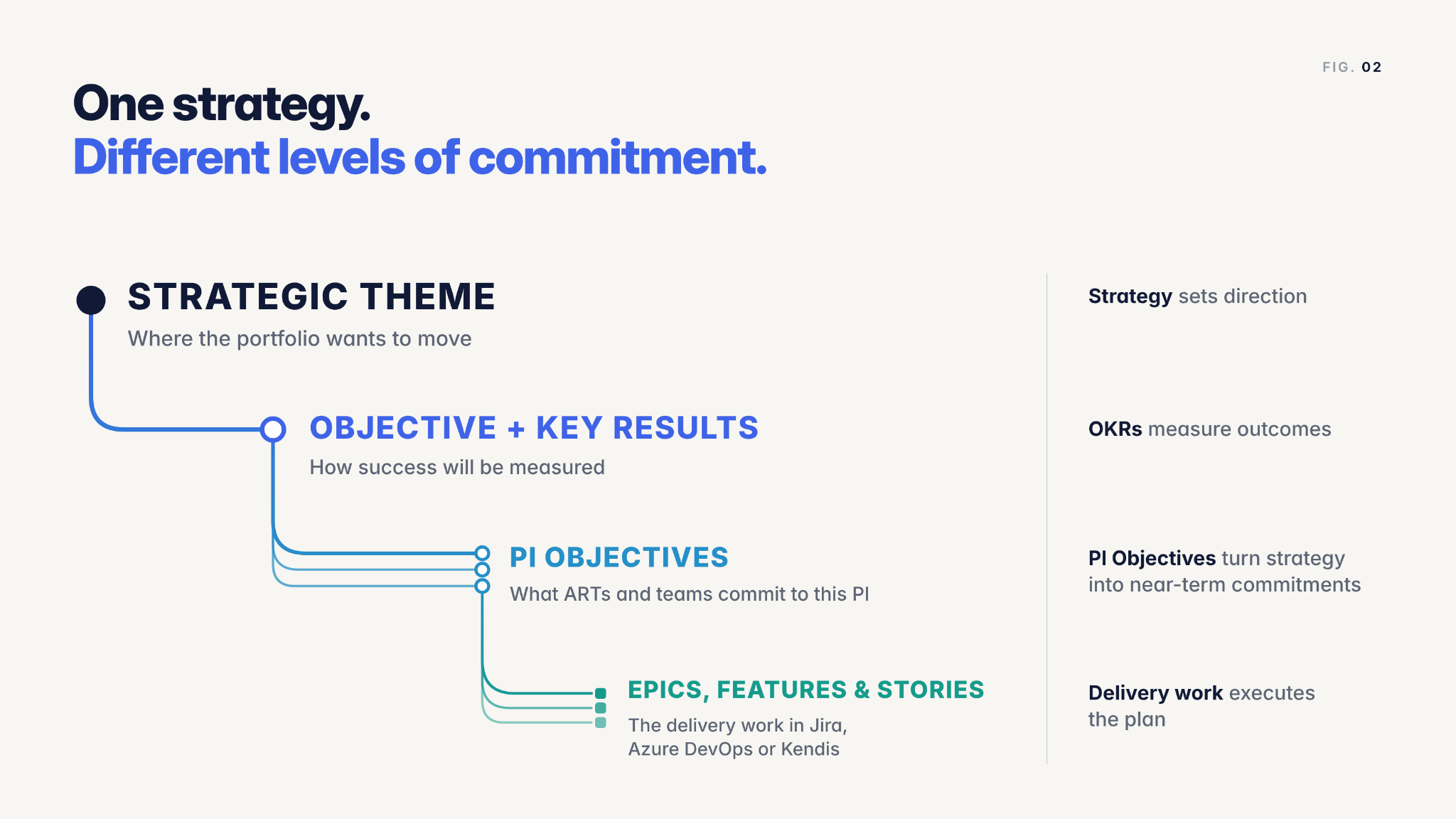
How Strategic Themes, OKRs and PI Objectives work together
These terms are related, but they are not interchangeable.
The important point is the connection between the layers.
A Strategic Theme without measurable Key Results is difficult to evaluate. An OKR without a connection to ART and team commitments can become a reporting exercise. A PI Objective without strategic context can be delivered successfully while contributing very little to the portfolio's priorities.
The useful question is therefore not only “What are our Strategic Themes?”
Can we trace each theme to the objectives, PI commitments and delivery work that are supposed to move it, and can progress travel back up without being manually reconstructed?
How do you track Strategic Themes from strategy to execution?
A practical Strategic Theme tracking model needs six things:
- Link Strategic Themes and OKRs to the work that moves them. Connect the Epics, Features, stories or other delivery work that contributes to each objective and Key Result.
- Measure each Key Result with the right evidence. Use business outcome data, linked delivery items or linked objectives according to what the Key Result is actually measuring.
- Make ownership visible across ARTs and teams. One Strategic Theme may depend on several groups, each with its own contribution.
- Let OKR progress roll up from delivery instead of being reported up. When evidence is linked, progress can move from delivery work to Key Results, objectives, Objective Groups and the Strategic Theme.
- Track Strategic Theme health, not just progress. Compare actual progress with the time available so leadership can see when an outcome is moving but still falling behind.
- Connect Strategic Themes to PI Planning and PI Objectives. Strategy should influence what ARTs and teams commit to, and PI Objective progress should be traceable back to the outcomes it supports.
After a few quick examples, we'll follow one Strategic Theme through those six steps in detail.
Strategic Theme examples in SAFe across industries
Strategic Themes should describe a meaningful business direction, not a project or Feature. The wording will vary by industry, but a useful theme is broad enough to guide investment and specific enough to measure through outcomes. Here are five illustrative examples:
These are examples, not templates. A Strategic Theme should reflect the portfolio's actual business context, while its Key Results should measure whether that strategic change is happening.
To see how one Strategic Theme moves from a portfolio-level goal into OKRs, ARTs, PI Objectives and actual delivery work, consider a more detailed example.
A Strategic Theme example in SAFe: cut solar connection time in half
Imagine an energy company.
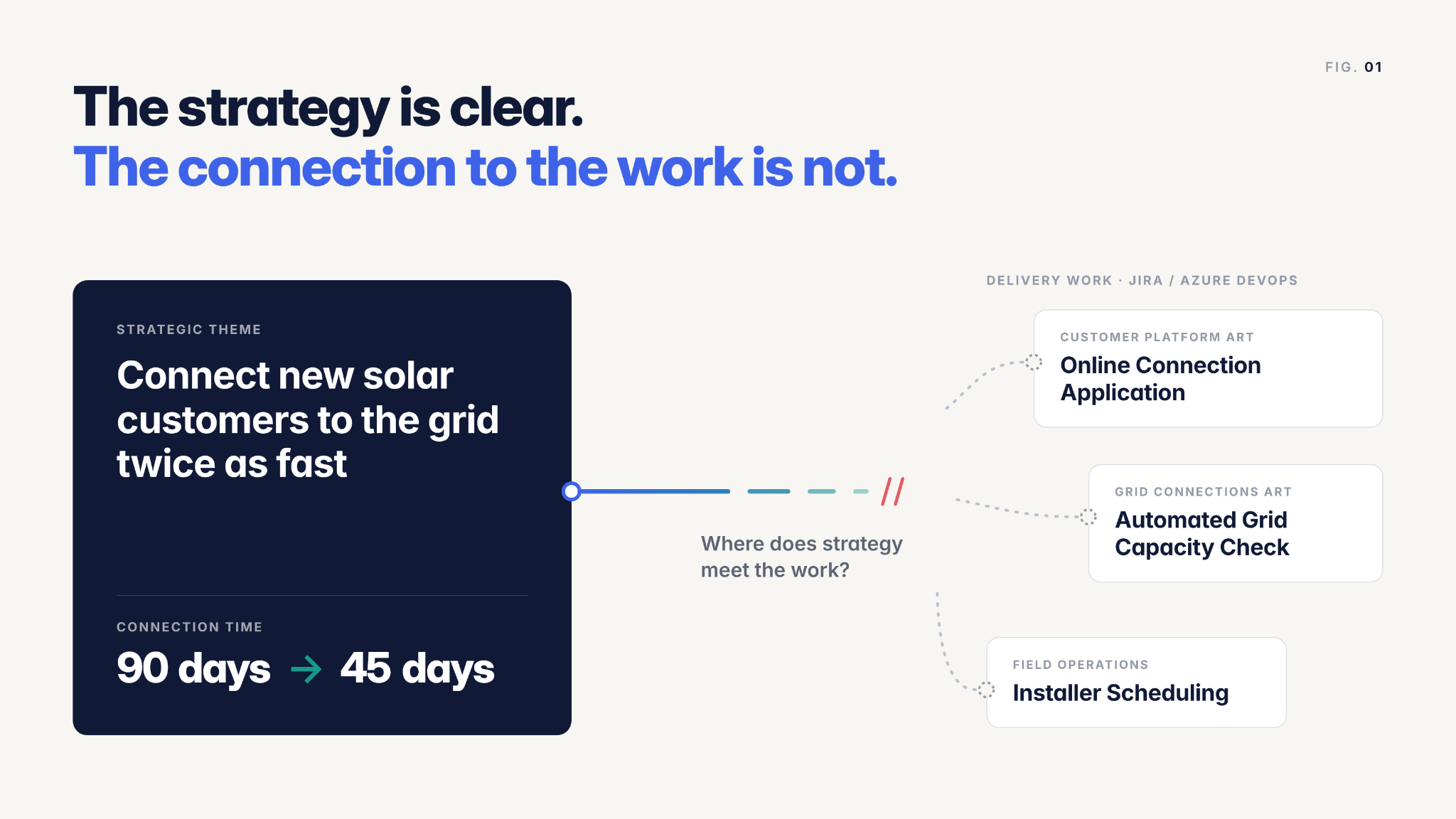
Demand for residential solar is growing, but connecting a new installation to the grid takes around 90 days. Customers wait, installers wait, and some customers abandon the process.
Leadership defines a Strategic Theme:
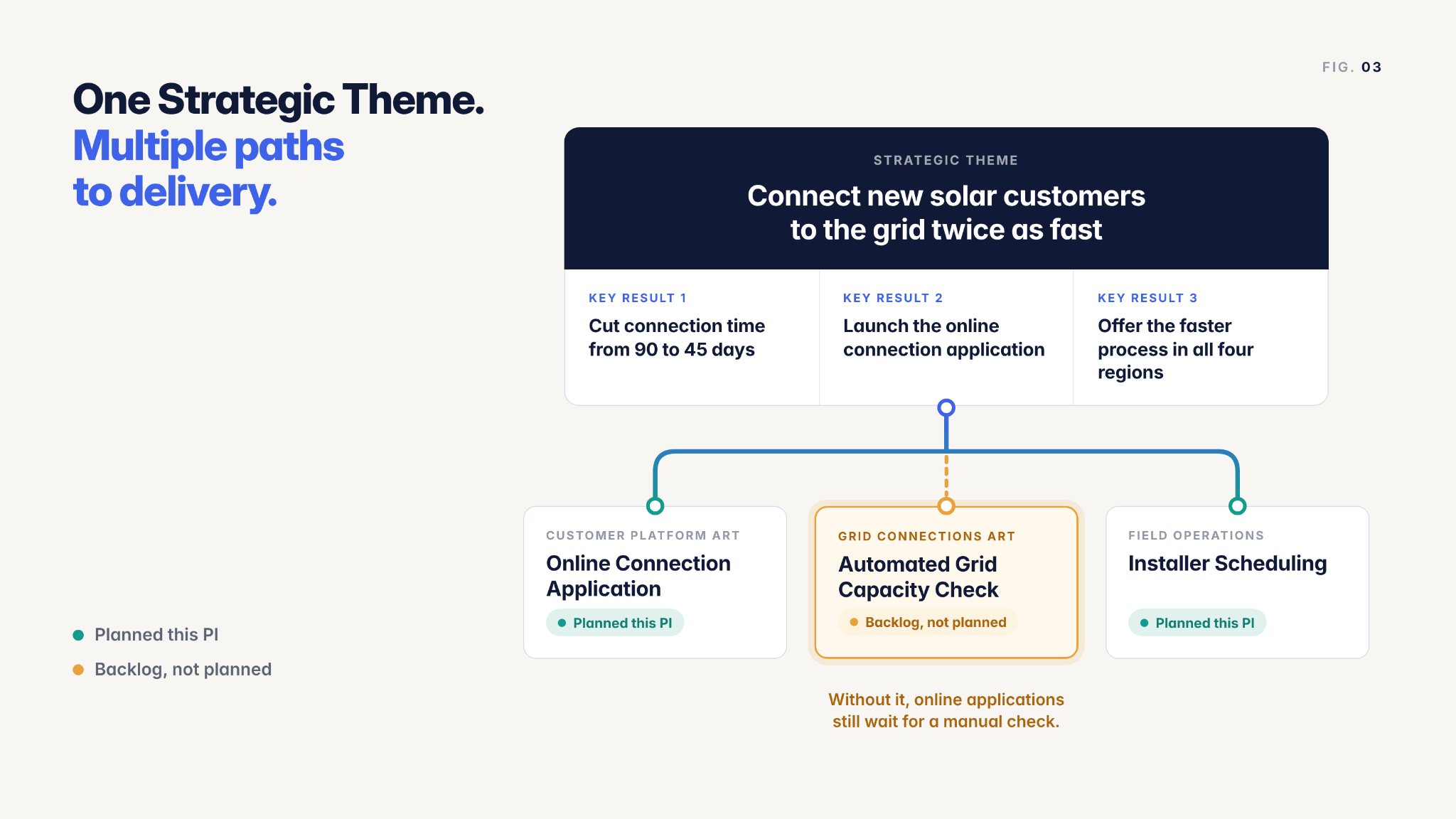
Connect new solar customers to the grid twice as fast.
Three groups contribute:
- Customer Platform ART, which owns the online application and customer portal;
- Grid Connections ART, which owns approvals and the technical review;
- Field Operations, which schedules installers and meter technicians.
The theme has three Key Results:
- cut average connection time from 90 to 45 days;
- launch the online connection application;
- offer the faster process in all four regions.
On a strategy slide, the theme looks complete.
The problem begins when leadership asks whether delivery is actually moving it.
1. Link Strategic Themes and OKRs to the work that moves them
The Customer Platform ART creates an objective:
Customers apply for solar connections online.
The Features already exist. Online Connection Application is planned by Customer Platform. Automated Grid Capacity Check belongs to Grid Connections and is still in its backlog.
But nothing connects those delivery items to the objective.
Without that link, leadership cannot see that:
- the objective depends on work from two different ARTs;
- a critical Feature is not planned in the current PI;
- the digital application will still wait for a manual capacity check even if the front end ships on time.
An objective becomes more useful when you can see the work behind it. Linking Epics, Features and stories from Jira or Azure DevOps gives the objective delivery context: what contributes, who owns it, where it is planned and whether it is moving.
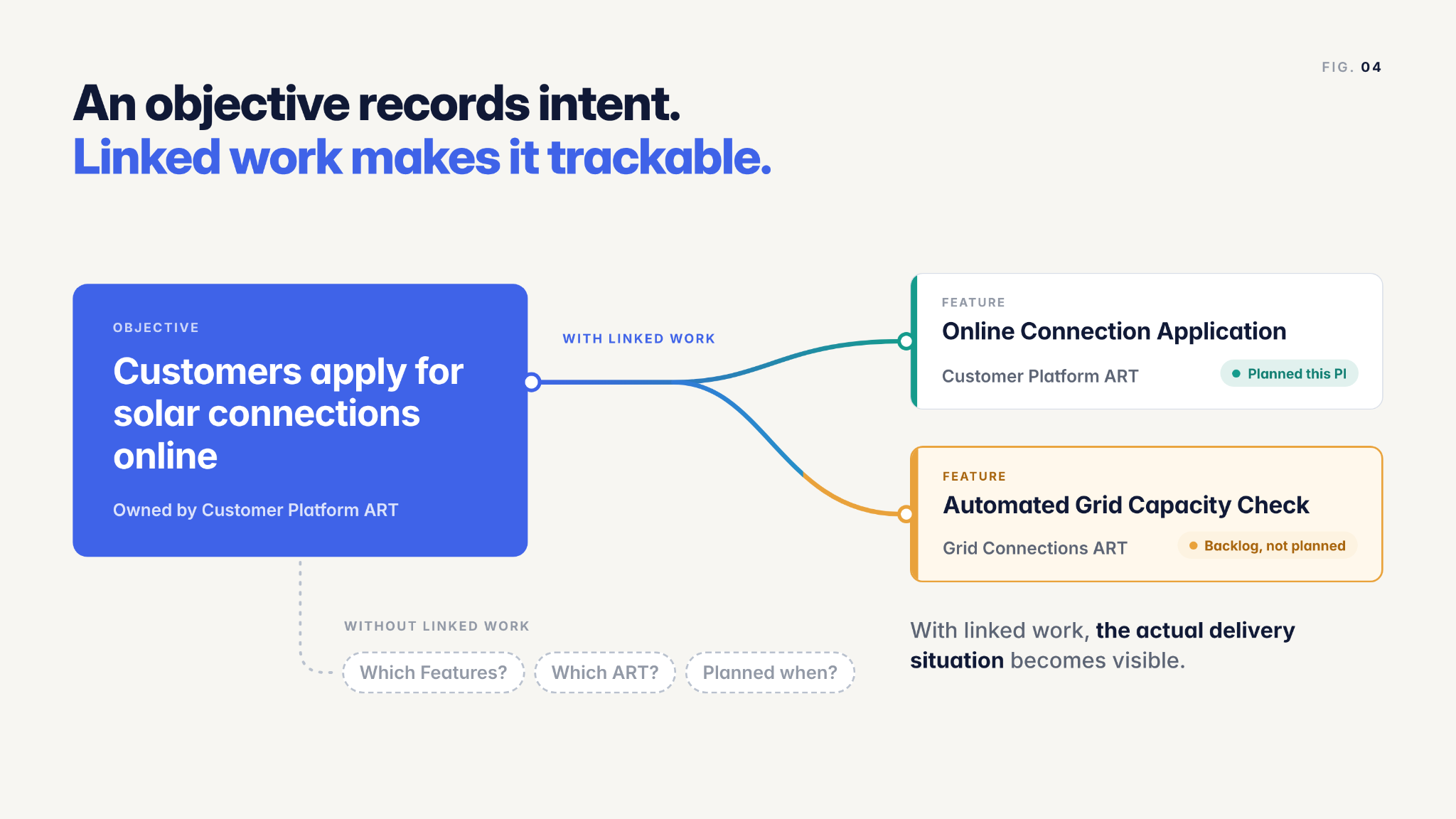
If you cannot see the work behind an objective, you cannot tell whether it is on track or only on the slide.
This is where strategy-to-execution traceability becomes practical. It is not about forcing executives into Jira. It is about letting the work already in Jira, Azure DevOps or Kendis provide evidence for the strategic outcome it supports.
2. Measure each Key Result with the right evidence
By June, the status report shows two of the three Key Results in green.
Customers are still waiting almost 80 days.
The problem is not the color. It is the measurement.
Cut average connection time from 90 to 45 days
This is a business outcome. No Jira ticket can tell you how long customers actually wait. It needs a target-based measure: starting value, target value and current operational result.
Launch the online connection application
This is primarily a delivery commitment. Its progress can come from the Features and other work required to deliver the application. As linked work moves, the Key Result can move with it.
Offer the faster process in all four regions
This depends on outcomes owned by several regional groups. Its progress can roll up from the objectives those regions own.
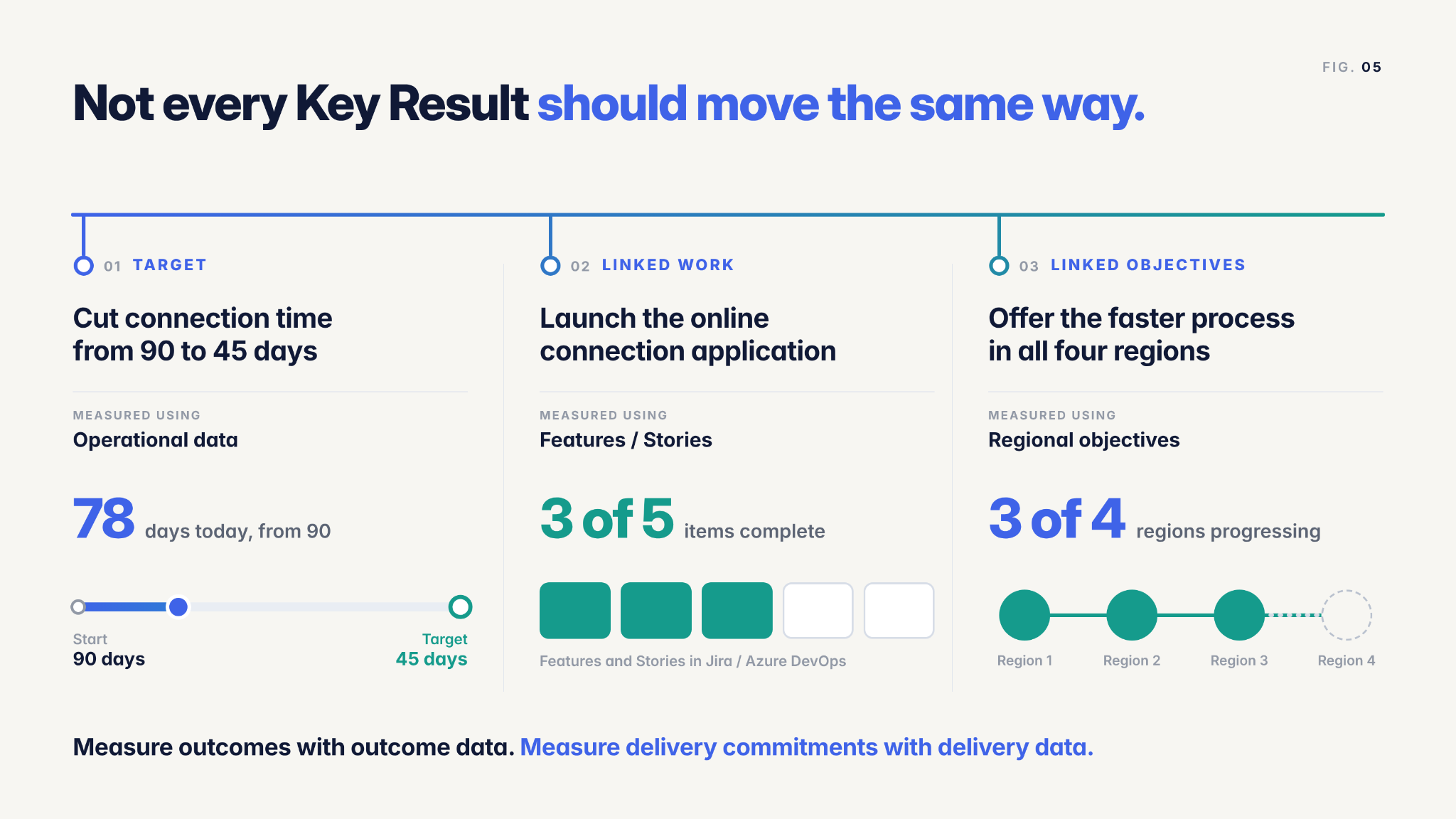
The mistake is using the same measurement model for every Key Result.
A business outcome measured by ticket completion can turn green while the customer result remains unchanged. A delivery commitment maintained as a manually updated percentage can stay optimistic long after the work has slipped.
Measure outcomes with outcome data. Measure delivery commitments with delivery data.
Should OKR progress come from Jira or Azure DevOps?
Sometimes. Jira or Azure DevOps can be excellent evidence for delivery-oriented Key Results, but they should not replace the business metric when the Key Result is an actual customer or business outcome.
3. Make ownership visible across ARTs and teams
A Strategic Theme may have one accountable owner, but execution rarely belongs to one group.
In the solar example, Customer Platform, Grid Connections and Field Operations all contribute to the same theme. If every objective sits in one long list, the overall progress number can hide which part of the system is falling behind.
Organize the theme so each contributing ART, department or team has a visible set of objectives and Key Results.
For example:
- Customer Platform owns the digital application experience;
- Grid Connections owns automated capacity checks and technical review;
- Field Operations owns installer scheduling;
- a cross-cutting Safety & Compliance group owns approvals that affect everyone.
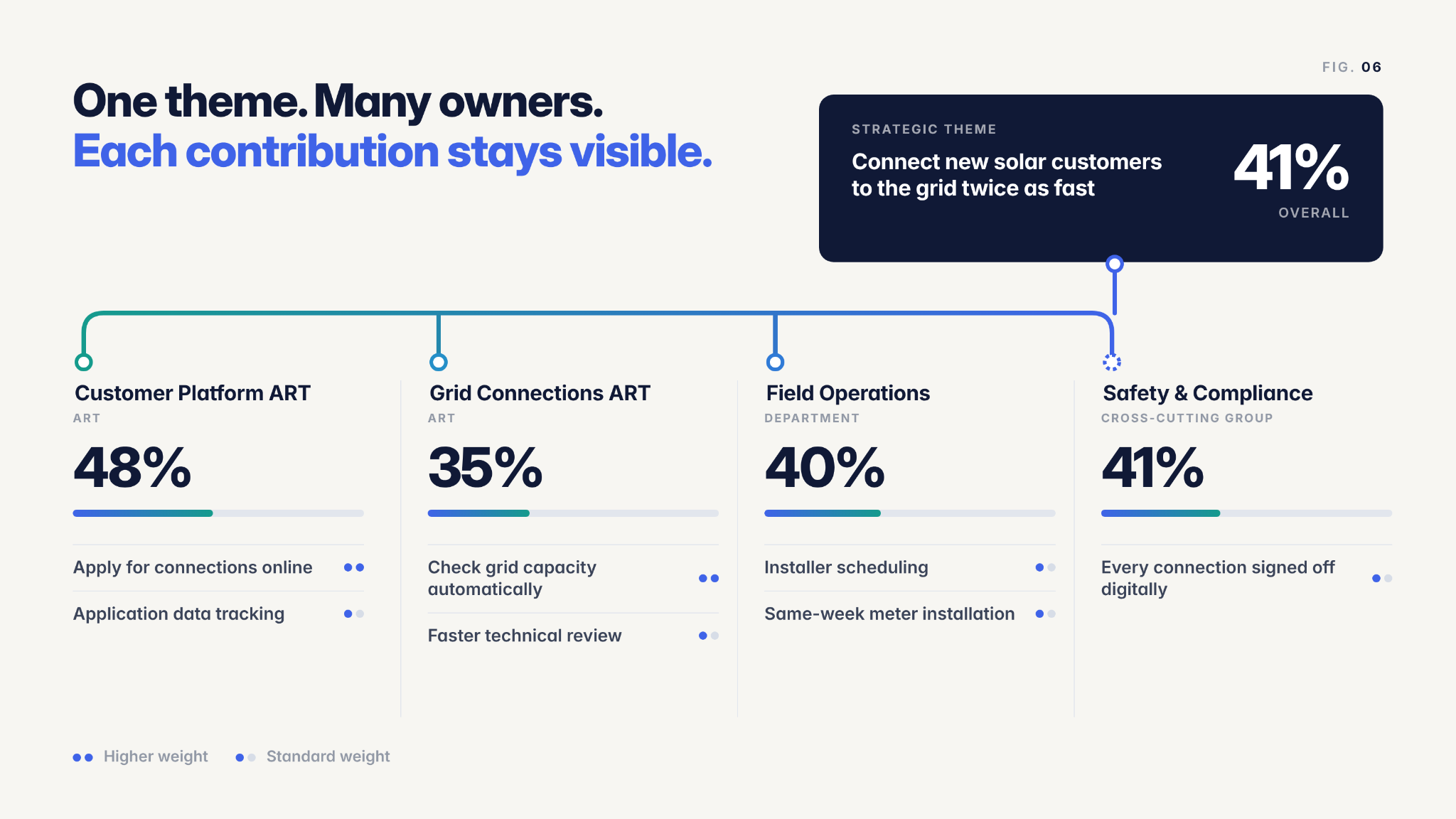
Now a review can answer a much better question than “Is the theme 41% complete?”
Which part of the theme is slowing the outcome down?
Weighting can also matter. Equal weighting is usually the easiest model to explain, but if one objective genuinely drives most of an outcome, its contribution can be weighted more heavily rather than allowing several small objectives to make the theme look healthier than it is.
4. Let OKR progress roll up from delivery instead of being reported up
This is the point where Strategic Themes stop being another reporting layer.
When the evidence is connected, progress can travel upward:
delivery items → Key Results → objectives → Objective Groups → Strategic Theme
When a Grid Connections Feature moves to Done, the delivery-based Key Result moves. The Grid Connections objective moves. Its Objective Group moves. The Strategic Theme reflects the change.
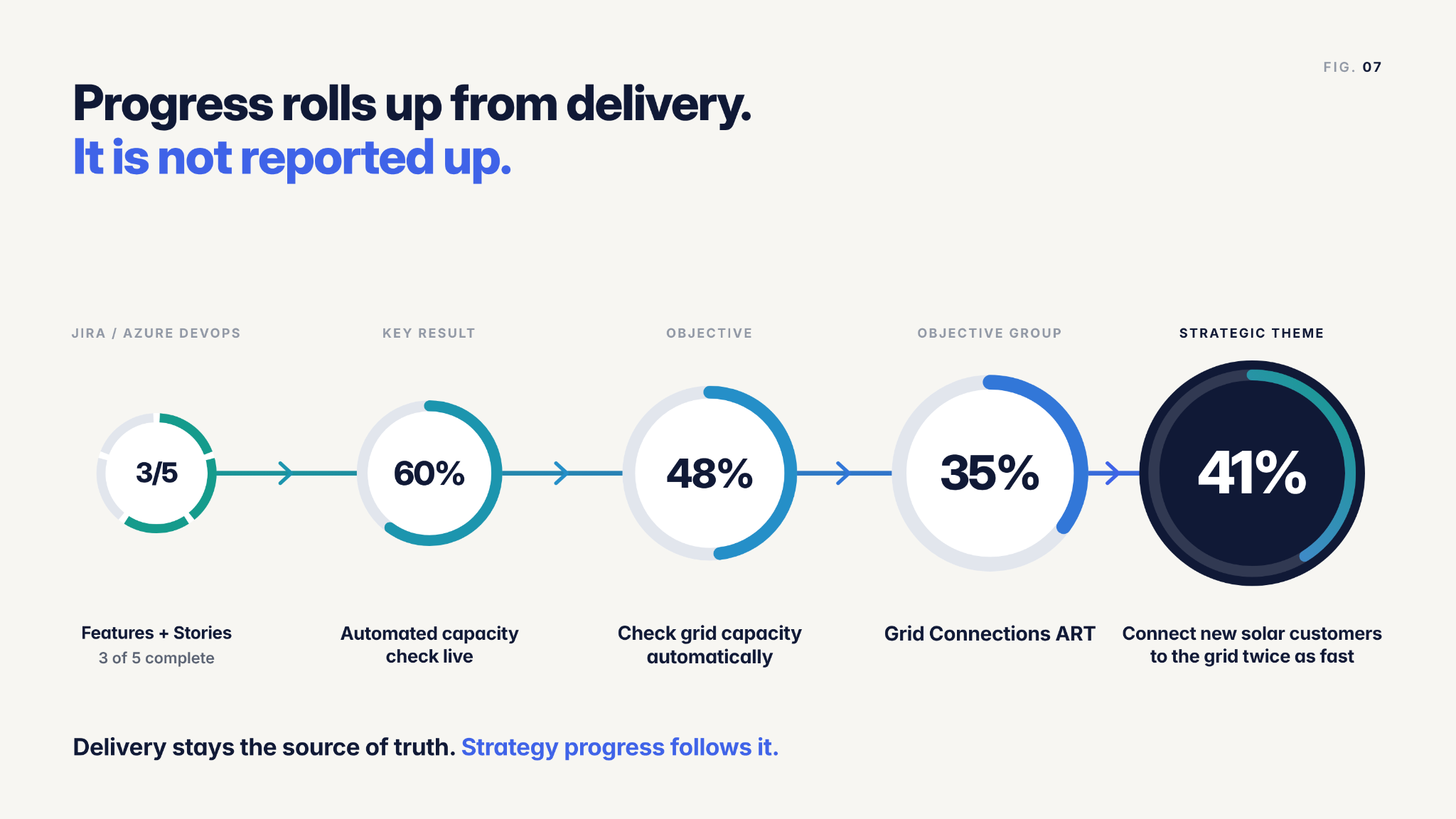
The underlying delivery system stays the source of truth. Teams do not need to copy status into another spreadsheet so leadership can see it.
That changes the strategy review conversation.
Instead of:
“Can everyone send me their status by Thursday?”
the question becomes:
“Why did this Key Result stop moving two weeks ago?”
That is a much more useful management conversation because the meeting starts with evidence rather than status collection.
5. Track Strategic Theme health, not just progress
Progress and health are not the same thing.
Suppose an Objective Group is 40% complete. That can sound reasonable. But if 70% of the time period has already passed, the same 40% tells a very different story.
A useful health model compares actual progress with expected progress based on elapsed time.
In the solar example, at 70% of the year:
- Customer Platform is 48% complete, 22 points behind, so it is At Risk;
- Field Operations is 40% complete, 30 points behind, so it is At Risk;
- Grid Connections is 35% complete, 35 points behind, so it is Delayed.
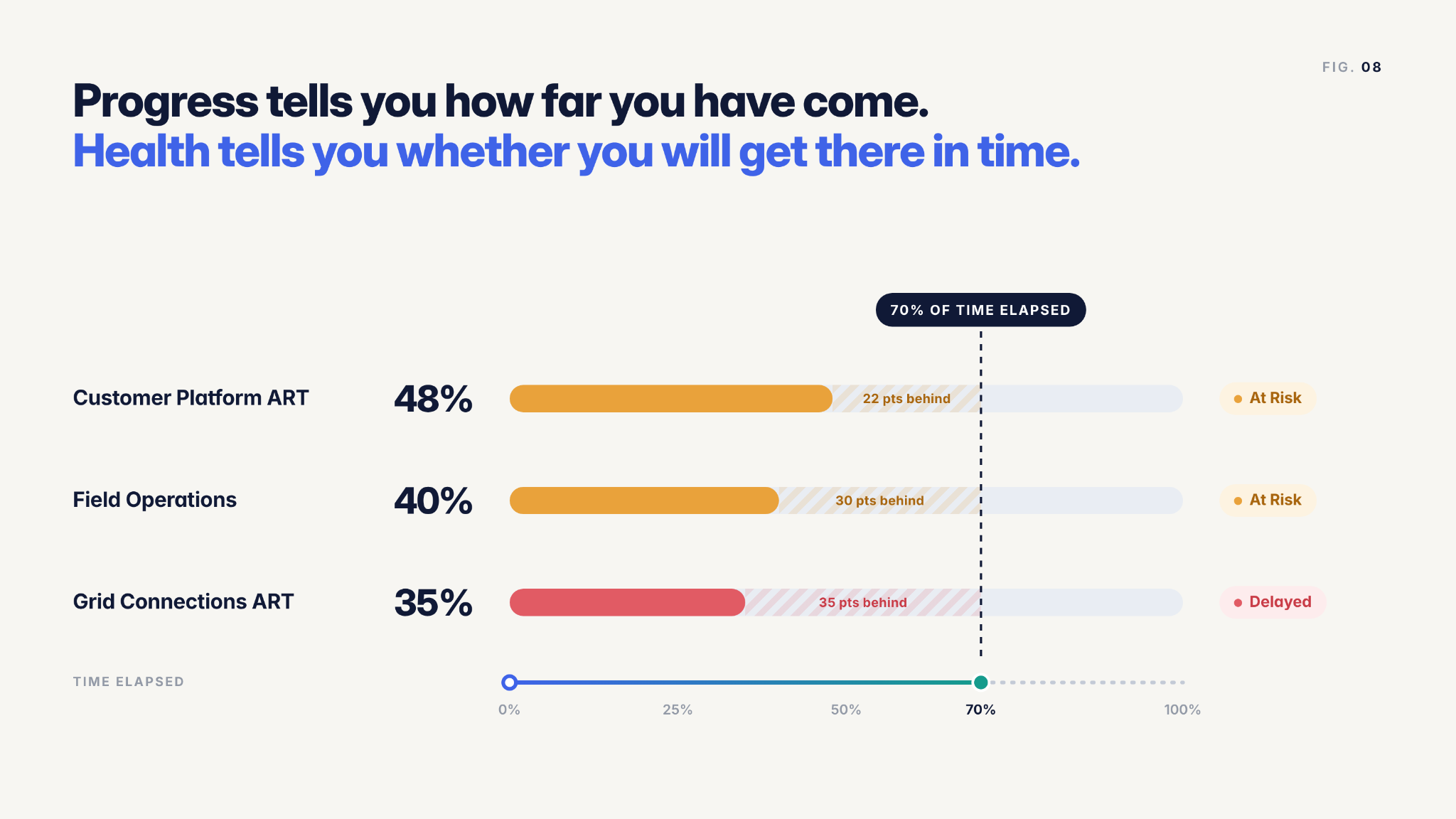
The progress bars are similar. The management situations are not.
Progress tells you how far you have come. Health tells you whether you are moving fast enough to get there.
For leadership, this is more useful than a manually selected red, amber or green status because it exposes a gap while there is still time to change scope, sequencing, investment or the target itself.
6. Connect Strategic Themes to PI Planning and PI Objectives
This is where many strategy-to-execution models break.
The Strategic Themes appear in the business context at PI Planning. ARTs hear the priorities, move into team breakouts, create their PI Objectives, plan Features and dependencies, and by the second day the Strategic Theme is a slide again.
The missing link is between the portfolio outcome and the PI commitments intended to move it.
A theme objective can also be brought into an ART's PI Board for planning. In the solar example, the Grid Connections ART sees Check grid capacity automatically as part of the planning context.
Teams can then link their PI Objectives to the Key Results they support.
For example:
- Strategic Theme: Connect new solar customers to the grid twice as fast
- Theme Objective: Check grid capacity automatically
- Key Result: Automated capacity check live
- Team PI Objective: Rules engine ready for all regions
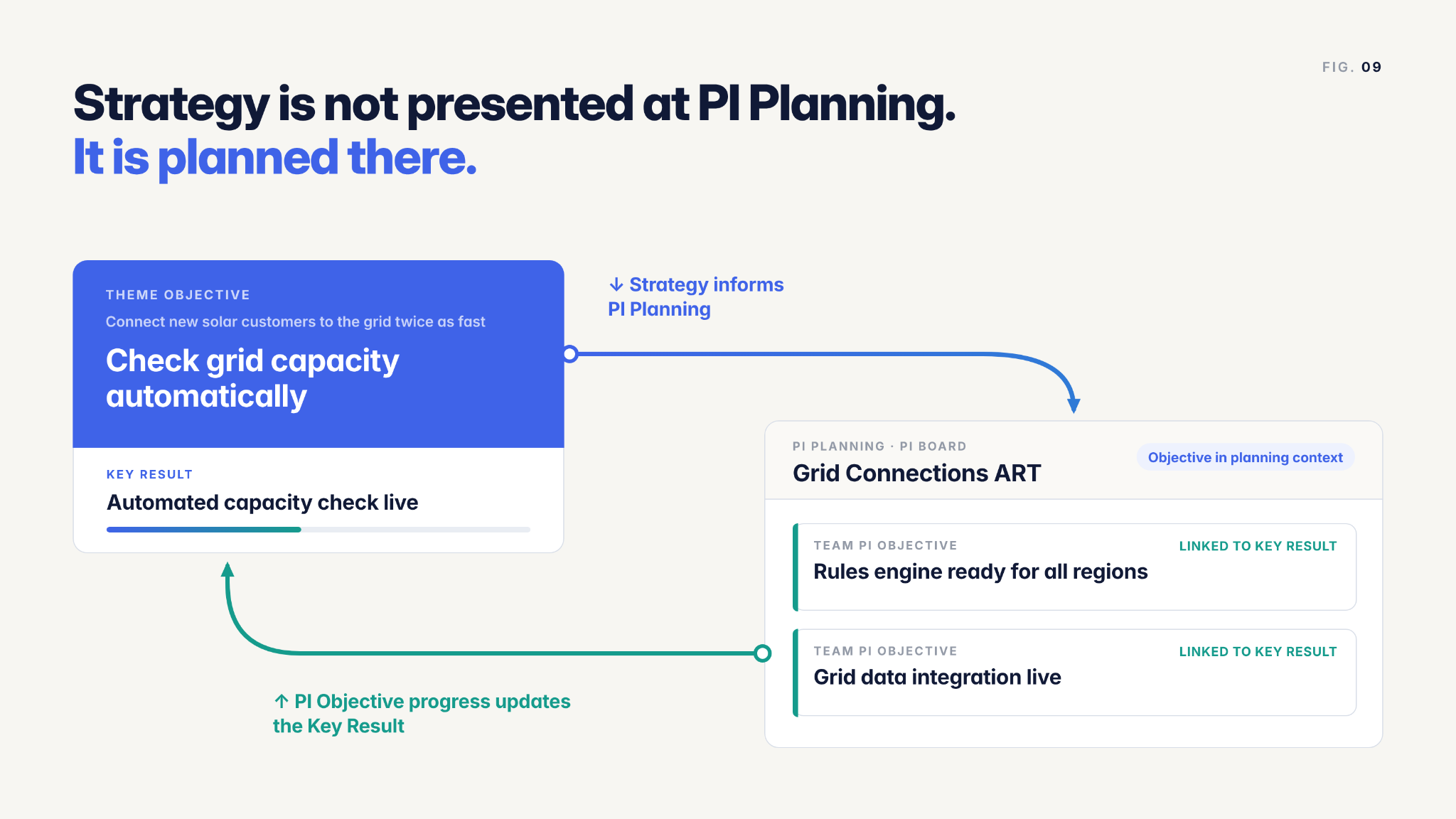
Now the connection works in both directions:
- the ART can see which strategic outcome its PI commitment supports;
- portfolio leadership can see which ART and team commitments are moving each Key Result;
- when a Key Result is measured by linked objectives, PI Objective progress can roll back into the theme.
Strategy is no longer presented at PI Planning. It is planned there.
This is also the practical difference between OKRs and PI Objectives. The OKR expresses and measures the strategic outcome. PI Objectives express what ARTs and teams intend to achieve in the next Planning Interval to contribute to it. They should reinforce each other, not compete as two separate goal systems.
Strategic Themes in Kendis: connect strategy to Jira, Azure DevOps and delivery
Connecting strategy to execution does not mean moving delivery work into a new system.
Epics, Features and stories can remain in Jira or Azure DevOps. Kendis Strategic Themes provides the planning and strategy layer around them.
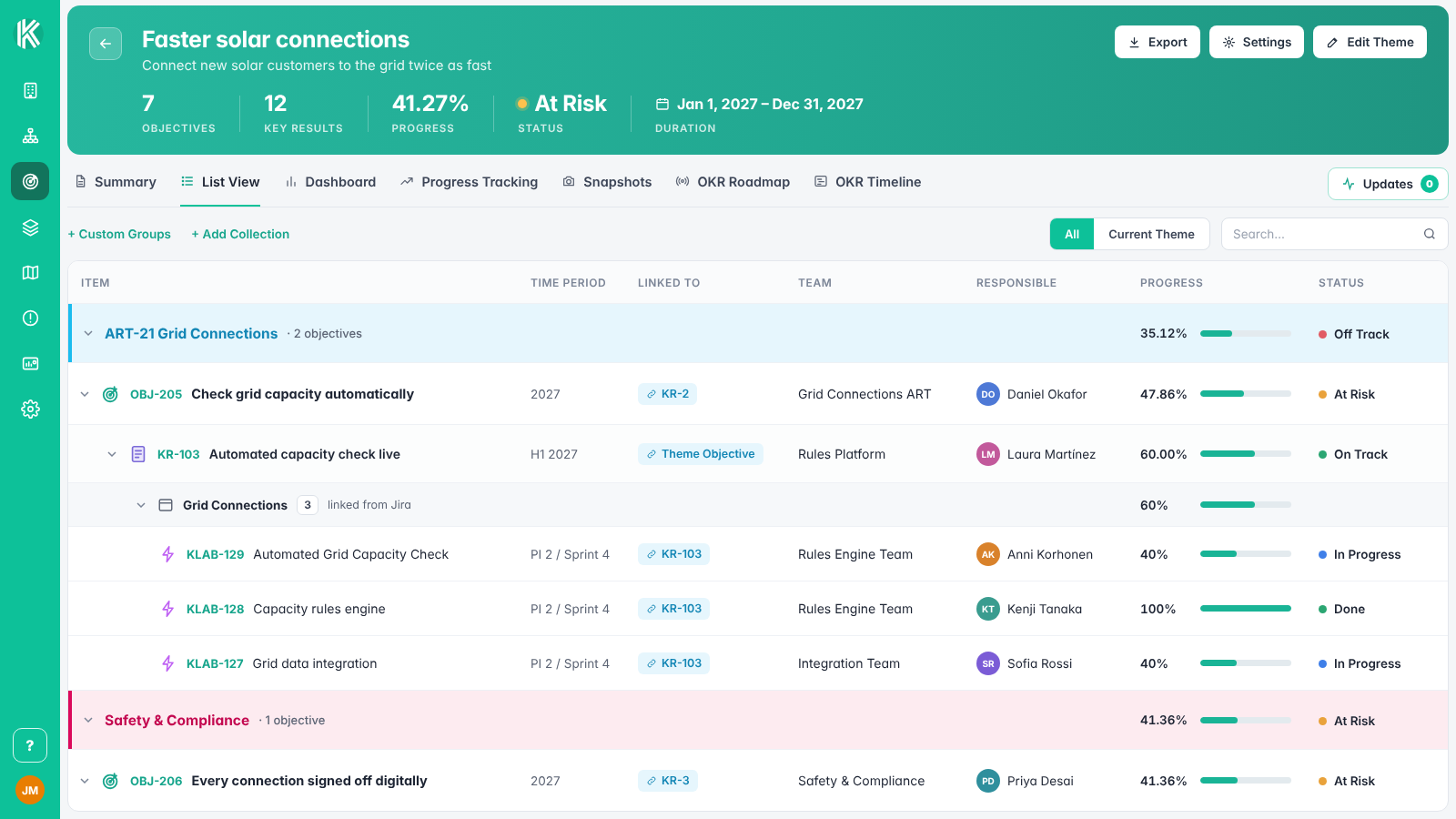
Within a Strategic Theme, organizations can:
- organize objectives and Key Results into Objective Groups for ARTs, departments or other owners;
- link objectives and Key Results to Jira, Azure DevOps and Kendis work;
- measure Key Results by a target, by linked items or by linked objectives;
- roll progress through objectives, groups and the overall theme;
- see progress, health, trends and team breakdowns in the Dashboard;
- use Progress Tracking, Roadmap and Timeline views for different strategy conversations;
- capture snapshots to compare what was committed with what changed;
- group multiple themes into portfolios for higher-level reporting;
- use Charlie AI, when enabled, to summarize theme progress and surface business-level insights.
The important design principle is simple:
Delivery work stays the source of truth. Strategy progress follows it.
That avoids creating a second delivery system while still giving portfolio leaders a view that is meaningful above the backlog level.
How to review Strategic Themes without another status spreadsheet
Once strategy and delivery are connected, the leadership review changes.
Once strategy and delivery are connected, four questions can be answered from the live theme.
Which work is moving this objective?
Linked Epics, Features and stories show the delivery evidence behind the objective, including work that is still in backlog or planned for a later PI.
In the solar example, Automated Grid Capacity Check becomes visible as soon as it is linked. Leadership can see early that it is not planned in the current PI rather than discovering the gap near year-end.
Is this Key Result measuring the right thing?
Each Key Result shows its measurement model.
Connection time is measured as an outcome target. The online application follows delivery items. Regional rollout follows linked objectives.
That makes it easier to challenge a green number that is measuring the wrong thing.
Who is falling behind?
Objective Groups and health signals show which ART or team is behind the expected pace.
When Grid Connections reach only 35% progress with 70% of the year gone, leadership can see the problem without waiting for someone to report it.
How are we doing on the Strategic Theme overall?
The Dashboard can show overall progress and health, group-level performance and trends. Progress Tracking shows how the theme has moved over time.
Snapshots add another question:
Are we still delivering the strategy we originally committed to, or has the content changed underneath the percentage?
A useful operating rhythm is:
- at commitment: capture the baseline;
- weekly: teams update the work and explain material changes;
- monthly: leadership reviews progress, health and the groups falling behind;
- at close: compare the final state with the original snapshot and discuss what changed, what was dropped and what was achieved.
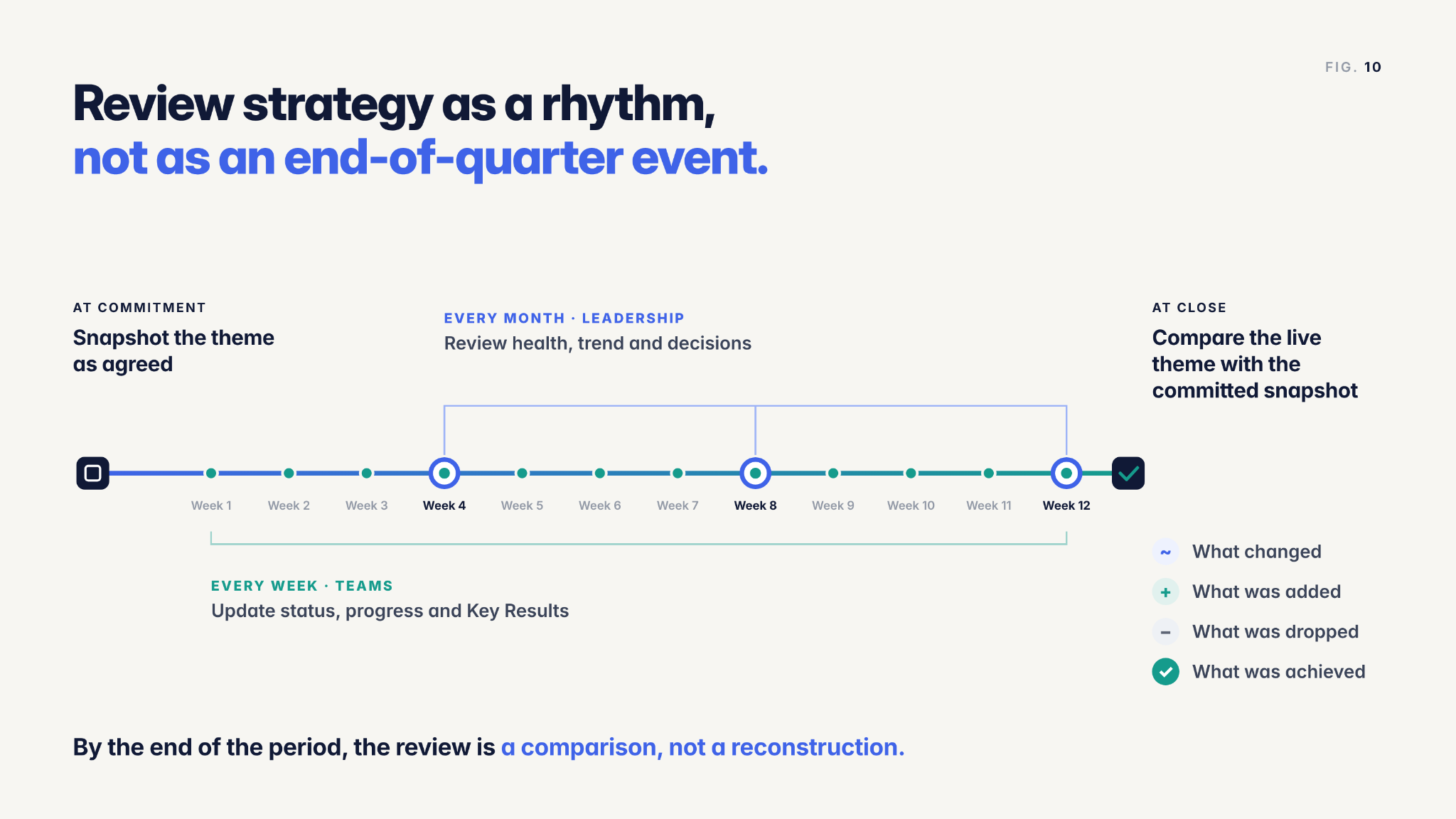
The numbers should already be there when the meeting starts.
The meeting is for deciding what to do about them.
The slide and the work should tell the same story
Strategic Themes are not difficult to write.
The hard part begins after the offsite, when the theme has to compete with backlogs, PI commitments, dependencies and day-to-day delivery.
That is why the most useful Strategic Theme question is not:
“Did we define the right OKRs?”
It is:
“Can we still see the connection between those OKRs and what the organization is actually doing?”
The slide shows what leadership wants to happen.
The backlog, PI Objectives and delivery data show what is actually happening.
A Strategic Theme becomes operational when those two views stay connected, progress can roll up from real evidence, and leadership can see a gap early enough to act.
Practical questions about Strategic Themes in SAFe
These questions focus on what changes once Strategic Themes move from a strategy document into real portfolio and PI-level execution.
How do Strategic Themes connect to PI Objectives in SAFe?
Strategic Themes set portfolio-level direction and define measurable outcomes. PI Objectives describe what ARTs and teams intend to achieve during the next Planning Interval to contribute to those outcomes. The connection becomes useful when PI Objectives are explicitly linked to the theme’s objectives or Key Results, so delivery progress can be traced back to strategy.
Can one Strategic Theme span multiple ARTs?
Yes. A Strategic Theme can depend on contributions from several ARTs, departments, platform teams or shared services. The important part is making each contribution visible. Separate Objective Groups or clearly owned objectives help leadership see which part of the strategy is progressing, which group is behind, and where coordination is needed.
What makes a good Strategic Theme in SAFe?
A good Strategic Theme describes a meaningful portfolio-level business direction, not a project or Feature. It should be broad enough to guide investment and prioritization, specific enough to express as measurable outcomes, and connected to the ARTs, PI Objectives and delivery work that will move it. The Key Results provide the evidence of progress.
What happens when delivery work behind a Strategic Theme is not planned?
The strategy can appear healthy while a critical part of the execution path is missing. Linking the objective or Key Result to delivery work makes that gap visible early. Teams can see whether the required Feature is planned in the current PI, sitting in backlog, owned by another ART, or not yet represented in the plan.
How do you know whether a Strategic Theme is on track?
Progress alone is not enough. A useful health view compares actual progress with the time that has elapsed and also exposes which objectives, Key Results or contributing groups are falling behind. A theme at 40% may be healthy early in the period and clearly at risk when 70% of the available time has already passed.
How often should Strategic Themes be reviewed?
Use different cadences for different decisions. Teams should keep delivery evidence and Key Result measurements current as work changes. Leadership can review progress, health and major gaps on a regular monthly cadence, while snapshots at commitment and close make it easier to compare what changed across the full strategy period without reconstructing the story manually.
For implementation details, see the Kendis Strategic Themes guide.