How to Help Your Teams Upskill for AI

41% of employees are struggling to fit AI into their daily workflows. And only 6% of individual contributors have received any guidance on how to do it.
Read that again. Not 6% who got great guidance. 6% who got any guidance at all.
AI tools have never been more capable, more accessible, or easier to use. This is a management problem — and it's one that most organizations are still choosing to ignore.
The Real Bottleneck Isn't the Technology
When organizations talk about AI adoption, the conversation almost always gravitates toward tooling. Which platform are you using? What's your AI stack? Have you rolled out Copilot yet?
But here's what those conversations are missing: demand for AI-ready skills now outpaces talent supply for half of all CIOs and the gap isn't closing by buying better software. It's closing by investing in people.
The uncomfortable truth is that most companies are dramatically over-investing in technology and dramatically under-investing in the humans expected to use it. You can't solve a people's challenge with a procurement decision.
Your managers are the missing link. They're the ones who translate strategy into daily behavior. They're the reason a team either thrives with a new tool or watches it collect digital dust. But right now, most of them haven't been equipped to lead that shift.
Why the Old Playbook Doesn't Work Anymore
Traditional Learning & Development L&D approaches weren't built for this moment. They tend to follow a familiar and increasingly ineffective pattern:
Train, then hope. You send a team to a half-day AI workshop, give them a Notion doc full of prompts, and expect them to figure out the rest. Training teaches concepts. It doesn't give managers a repeatable framework for guiding a team of eight people — with eight different roles and eight different workflows through meaningful skill development.
Deploy, then disengage. Licenses get purchased. Tools get deployed. And then the assumption is that adoption will follow. It doesn't.
The issue was never access — 73% of knowledge workers already use personal AI tools for their jobs.
The issue is that there's no structured path from experimenting alone to building capability together.
Add AI on top of existing work. This is perhaps the most common mistake. Organizations treat AI skill-building as a separate initiative — a training program to complete, a certification to earn. But people aren't going to carve out extra time in already-packed schedules for abstract upskilling. The learning has to happen inside the work they're already doing, not alongside it.
The Psychology Behind the Resistance
Here's something worth sitting with: 90% of employees are willing to adapt the way they work. The willingness is there. What's missing is trust — and that trust is built through experience.
Only 20% of organizations have built enough change-management credibility for employees to genuinely believe that this initiative will be different from the last one. If your team has been through two years of "transformation" announcements that didn't go anywhere, skepticism about AI is rational, not lazy.
This means that before you can build AI capability, you likely need to rebuild trust. And that starts with managers being honest about what's changing and why — not just announcing what tools are being rolled out.
What Actually Works: A Practical Framework
1. Make managers into role models, not just messengers
The single highest-leverage action you can take is getting your managers to use AI visibly and openly — in meetings, in one-on-ones, in the way they approach planning. Research shows that when a manager actively demonstrates AI usage, team members are significantly more likely to become strategic AI collaborators themselves.
This isn't about managers pretending to have all the answers. It's about modeling curiosity. Ask your team: Which parts of your work feel like the most friction? Where do you lose the most time? Then explore, out loud, whether there's an AI-assisted approach worth trying.
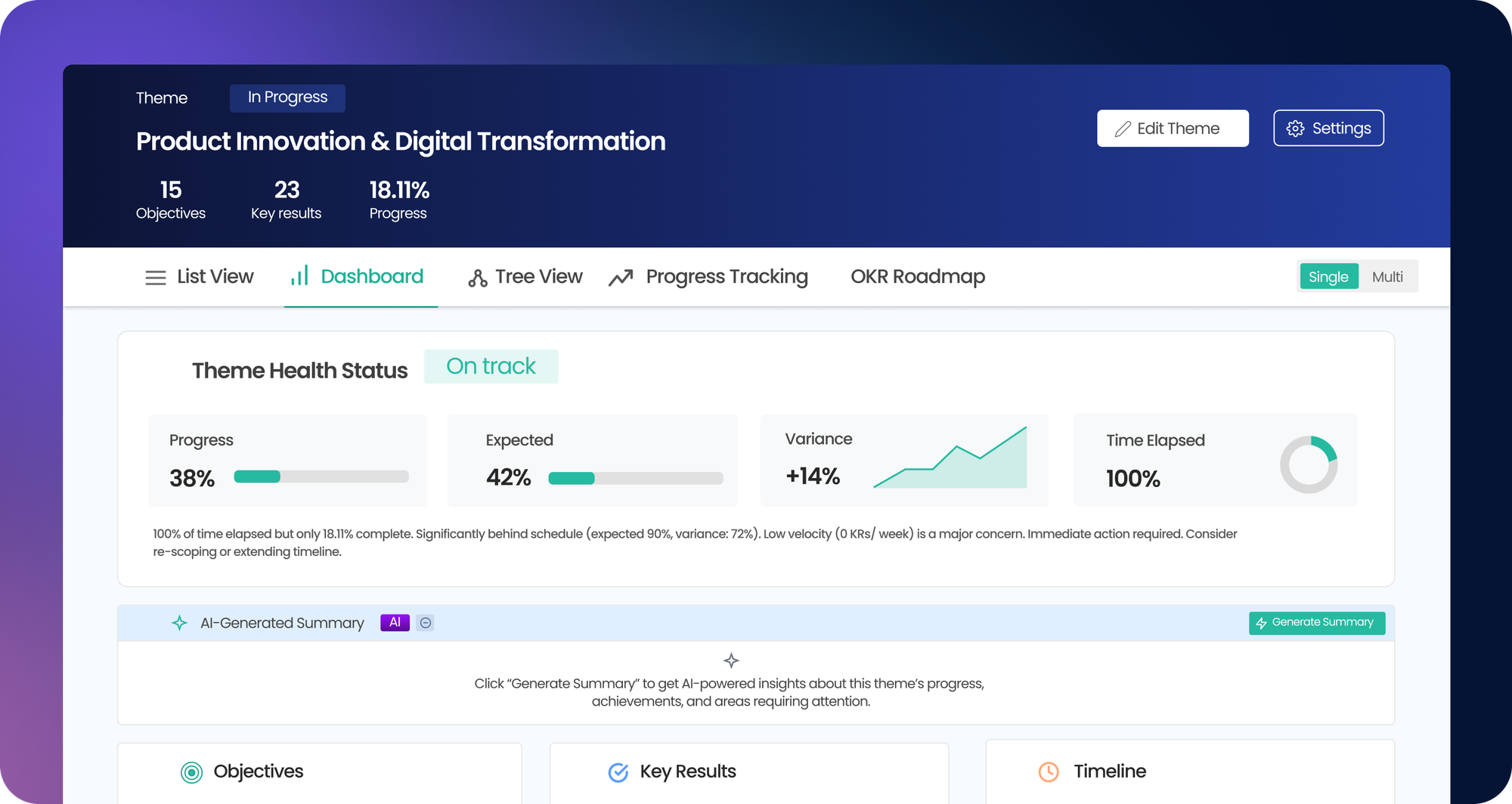
Tools like Charlie by Kendis are designed with exactly this kind of daily integration in mind — helping managers and their teams surface blockers, track progress, and keep work moving without adding another layer of overhead. When AI assistance lives inside the flow of standup and planning, rather than in a separate app to open and remember, adoption stops being a discipline problem.
2. Embed AI into the work, not alongside it
The 41% of employees struggling to fit AI into their workflows aren't failing because they lack technical skills. They're failing because the tools live in a separate ecosystem from where work actually happens.
Map your team's actual workflows. Where do handoffs slow down? Where does information get lost between tools? Where do people spend time recreating context that should already exist somewhere? Those are your integration points.
Kendis AI takes this approach seriously — it's built to sit inside the planning and delivery layers your teams are already using, not to require a context switch. When AI suggestions appear in the tool you're already working in, they get used. When they require a separate login and a fresh prompt, they don't.
The goal isn't for AI to be "something we also do." It should feel like invisible infrastructure — the work people already do, made faster and less painful.
AI in PI Planning & Tracking
3. Build skills through peer learning, not programs
Formal training has its place, but it's a starting line, not a finish line. The fastest-evolving capability in most organizations right now is peer knowledge — who figured out a prompt that saves them an hour a week, who redesigned their retro process with AI assistance, who found a way to auto-generate the status update nobody wanted to write.
Find those people and make their contributions visible. Create a simple ritual — a 10-minute slot in your all-hands, a dedicated Slack channel, a monthly lunch-and-learn — where internal AI wins get shared in concrete, replicable terms. Peer-to-peer learning is often more effective than structured curricula and infinitely faster to evolve.
4. Define what "AI-ready" actually means for each role
One reason employees feel stuck is that "AI skills" is too abstract to act on. A product manager needs different AI capabilities than a customer success rep. A data analyst's use cases look nothing like a project coordinator's.
Get specific. For each function, define two or three high-value use cases where AI can make a meaningful difference. Build a simple skills matrix that makes growth conversations concrete. And track impact — time saved on a specific workflow, quality of outputs, reduction in back-and-forth — not just adoption rates or tokens spent.
5. Treat AI readiness as a continuous evolution, not a project
The companies seeing the best returns on AI aren't the ones who ran the best rollout. They're the ones who built ongoing mechanisms for learning and adaptation.
Set up internal communities where early adopters share what's working. Run quarterly reviews of your AI toolset — what's earning its place, what's creating noise. Make space for experimentation without demanding immediate ROI on every pilot. And keep having the hard conversations about what's broken in your workflows, because AI amplifies both the good and the bad. It won't fix a fragmented knowledge base. It won't compensate for unclear goals. But for teams that are already functioning well, it can be genuinely transformative.
The Platform Question
One last thing worth saying: your tech stack is a reflection of your culture. When teams have to context-switch between a dozen tools to get through a single day, the message that sends — intentionally or not — is that coherence isn't valued here.
Unified, collaborative environments change adoption dynamics. When AI lives inside the spaces where planning, coordination, and delivery already happen, it becomes a shared capability rather than an individual exercise. Teams don't need to remember to use it. It's just there, with context, at the moment it's useful.
That's the philosophy behind Kendis AI and Charlie by Kendis — not AI as an add-on, but AI as part of how work gets done. Surfacing blockers before standup. Drafting summaries so your team can focus on decisions, not documentation. Keeping distributed teams aligned without multiplying meetings.
The Bottom Line
The organizations building AI capability fastest aren't the ones with the most sophisticated tools. They're the ones treating AI readiness as a human challenge first — investing in managers, building trust before rolling out tools, and making learning a natural part of how work gets done.
Your teams are more ready than you think. The technology is ready too. The question is whether management is.
That's the one thing no AI tool can do for you.