Objectives vs Features: Why do we need objectives in quarterly planning when we have features?

If you’ve spent any time in a quarterly planning session, you’ve likely witnessed the "Feature Factory" in full swing. The room is filled with backlogs, Gantt charts, and a roadmap bursting with "what" we are building. The mindset is often tactical: if we ship these ten features by Friday, we’ve won. But here is the dilemma: being efficient is not enough to be successful. As Gino Toro aptly puts it,
“If we look at software delivery as a water pipeline, we can spend all our time improving the capacity and flow, but if that pipeline contains sewage, we simply kill the product faster”
This is the real cost of feature-first planning. It's not that features are wrong — it's that features alone are incomplete.
Features are a unit of functionality. They describe what will be built. It's scoped, estimated, and assigned to a team.
That's it. That's the full contract.
And for a long time, that felt like enough. If the feature ships on time, within scope, and passes QA — the team has delivered. Celebrate the sprint review. Update the roadmap. Move to the next one.
But a feature tells you what to build. It doesn't tell you why it was chosen over the five other things that didn't make the cut. It doesn't tell you what will change for the customer once it ships. It doesn't give teams a shared definition of what success actually looks like at the end of the quarter.
What you get instead is a team that's busy, a backlog that's moving, and a leadership team that's quietly unsure whether any of it is compounding into something meaningful.
The Reality of Program When You Have Features Without Objectives
- Alignment becomes accidental. Multiple teams may be building features that touch the same user journey but without a shared objective anchoring them, they're each optimizing for something slightly different. One team is focused on performance. Another is adding capabilities. Nobody has explicitly agreed on what this quarter is for.
- Prioritization becomes political. When there's no outcome anchor, feature priority defaults to whoever pushed hardest in the last planning session, or whatever's been on the backlog the longest.
- Pivoting becomes painful. Mid-PI, reality diverges from the plan — it always does. New dependencies surface. A team hits capacity issues. Scope needs to flex. Teams with only a feature list on the wall don't have a clear basis for trade-off decisions. Do you drop Feature C to protect Feature A? Without an objective to reference, that conversation is a negotiation. With one, it's a judgment call. Big difference.
How Objectives Turn Planned Work into Measurable Outcomes
Here's where the perspective shifts.
An objective doesn't describe what will be built. It describes what will change — for a customer, for a market position, for an internal capability
Objectives are the "Why" behind the "What". They are the difference between saying "We are building a new checkout page" (output) and "We are reducing cart abandonment by 15%" (outcome).
An outcome is a change in human behavior that drives business results. While features are the means, objectives are the reason.
When you lead with objectives:
- Prioritization becomes objective: You don't build a feature because it’s "next in line"; you build it because it’s the most viable path to your objective.
- Agility is actually possible: A feature-only roadmap is rigid. If a feature fails, an objective-based team has the autonomy to pivot and try different experiments until the desired outcome is met.
- Cross-team Synchronization: In complex setups like PI Planning, objectives provide a shared language. It’s much easier to manage dependencies when teams understand the collective value they are trying to unlock.
- Motivation and Purpose: Employees are more motivated when they understand how their daily tasks contribute to a greater good. Knowing the impact of their work enhances their connection to the project.
The Dilemma: Why Do We Focus on Outputs?
If outcomes are so superior, why do 54% of product roadmaps still focus on outputs?
- Outputs are easy to measure: It's simple to say "we shipped the dashboard". Proving that the dashboard led to a 15% increase in retention is much harder and takes longer to manifest.
- Environments reward outputs: Executives ask for delivery timelines, and investors want to see movement. Shipping something lets us "close the loop" and get a dopamine hit of being "done".
- False sense of certainty: Roadmaps packed with features look good on slides; they feel concrete. Outcomes—changes in behavior—are messier and harder to guarantee.
Technology is Finally Catching Up With the Practice
For years, the biggest practical barrier to objective-led planning was the overhead. RTEs had to maintain two parallel views — the feature board and the objectives tracker. Progress against outcomes lived in spreadsheets. The link between a completed feature and a moved objective was always implicit, never automatic.
That gap has closed.
Modern portfolio management platforms like Kendis now support outcome-based planning natively — connecting features to PI or quarterly Objectives, objectives to strategic themes, and themes to portfolio-level progress in a single system. When a feature ships, progress can roll up automatically. When key results update, leadership sees the downstream impact immediately. The manual translation layer that made objective tracking feel like extra work simply disappears.
Which removes the last legitimate excuse for not using them.
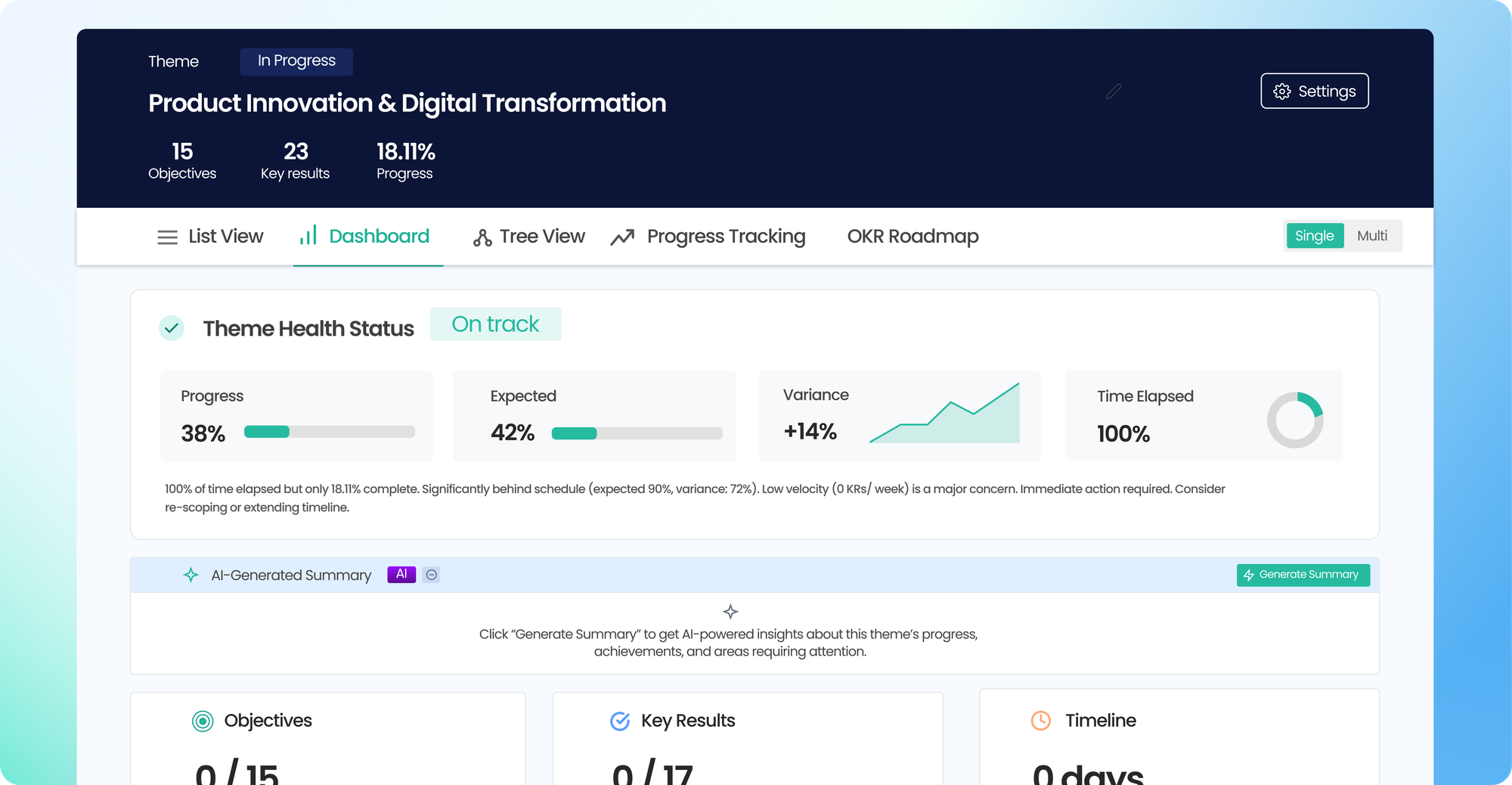
AI-Powered Objectives Creation and Tracking Across the Portfolio — with Kendis
Kendis goes further than connecting features to objectives. It makes the entire objective lifecycle — from creation to portfolio-level tracking — faster, smarter, and genuinely low-effort.
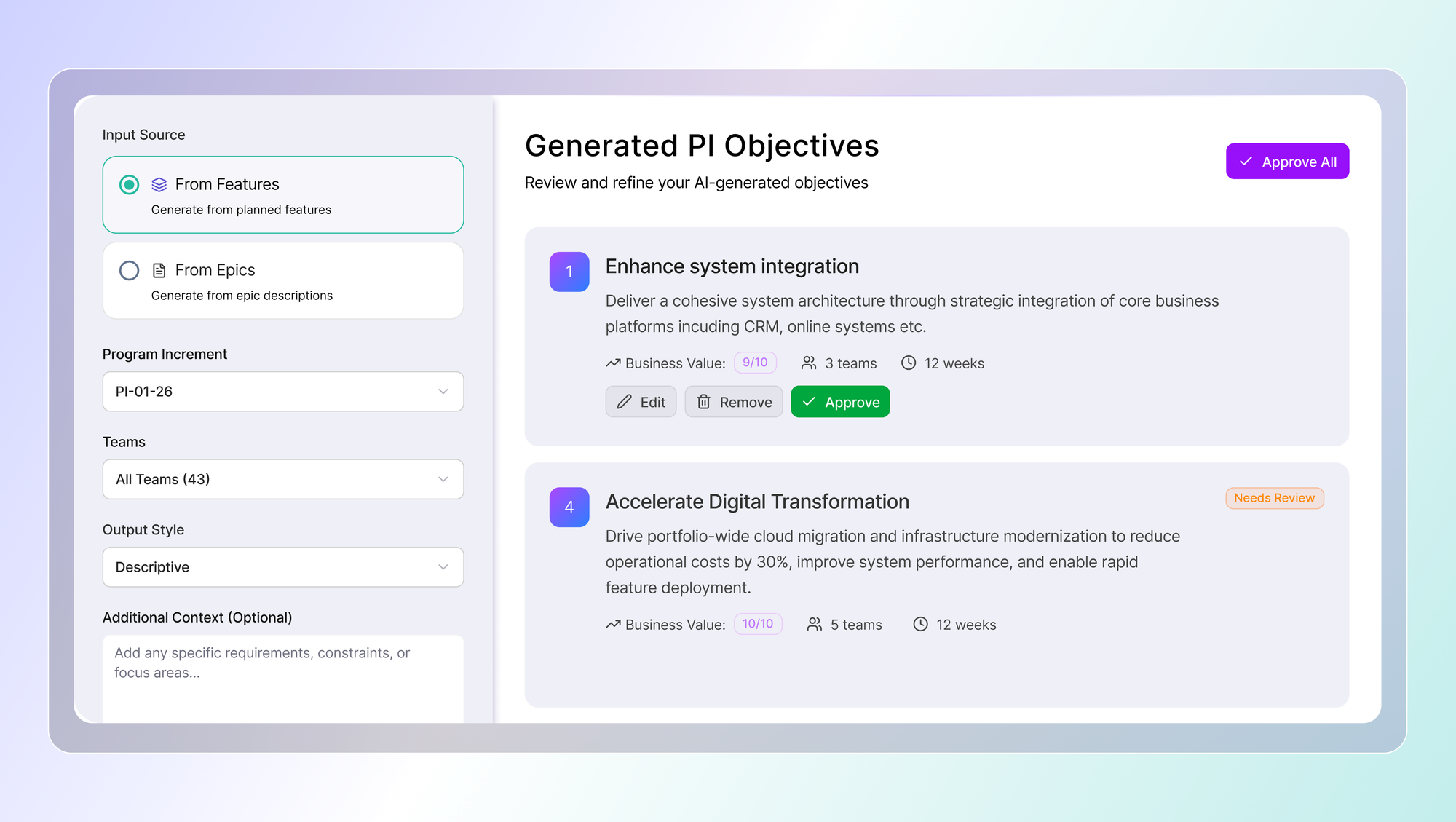
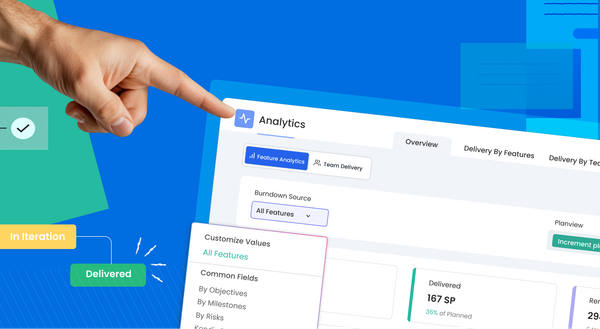
During PI Planning, teams create and commit to quarterly objectives directly in Kendis, linked to the features and stories that will drive them. As the PI progresses, objective completion updates in real time, giving RTEs and Program Managers a live view of outcome delivery not just feature throughput.
At the portfolio level, Kendis's AI, Charlie, generates intelligent summaries across strategic themes and portfolios. Charlie analyses progress vs. time, surfaces delivery risks, flags objectives that are drifting, and identifies where execution is diverging from strategic intent. Leaders get an honest, real-time picture of whether the organization is delivering value — and where attention is needed before the end of the quarter.
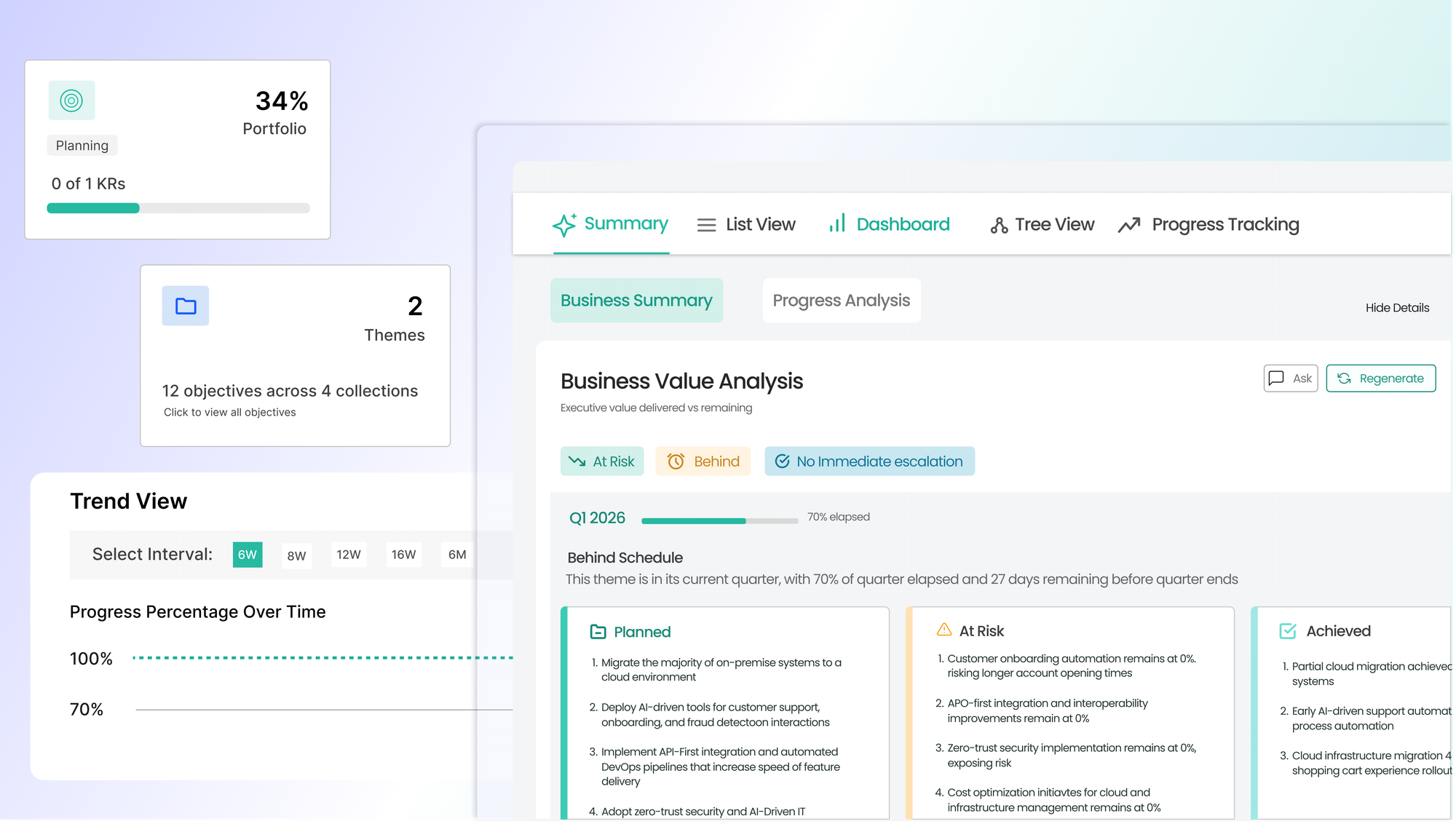
The structure in Kendis makes this possible at scale: Portfolio → Strategic Theme → Objective → Key Result — every level tracked, every level connected. A portfolio spanning multiple themes and dozens of objectives rolls up into a single dashboard, updating automatically as teams execute. Progress visibility that used to require a dedicated program analyst now runs in the background.
See how Kendis tracks objectives and portfolio health across your entire delivery hierarchy →