Outcome-Based Delivery in the Age of AI: Stop Shipping, Start Proving

Most Agile teams still measure success the same way factories measure success.
“How many units did we ship?”
Epics, Features, Stories, Bugs. Tickets. Velocity. Release notes that read like a supermarket receipt.
And then everyone wonders why the business isn’t moving.
If what you shipped doesn’t change customer behavior, reduce cost, increase revenue, lower risk, or unlock a strategic capability, you didn’t deliver an outcome. You delivered activity.
That might look productive on a dashboard, but it is the corporate equivalent of running on a treadmill and calling it travel.
The uncomfortable truth: output is easy to count. Outcomes are harder. So organizations default to what is measurable, not what is meaningful.
AI is forcing this conversation into the open, because it exposes the gap brutally. If your planning and delivery system cannot prove value, AI will not magically fix it. It will just automate your confusion.
Outcome-based delivery is not a new ideology. It is the moment Agile actually grows up.
Understanding Outcome-based delivery
Outcome-based delivery is the practice of measuring success by real, observable business impact rather than completed work. Instead of asking “Did we ship it?” teams ask “Did it move the needle — and how do we know?”
In outcome-based delivery, delivery is only valuable when it produces evidence: customer behavior changes, business metrics shift, risks are reduced, or strategic intent is measurably advanced.
Strategic Planning Without Outcomes
Most companies can describe their strategic planning in a PowerPoint.
Very few can trace it into real work.
They have “strategic priorities” floating around at the top, and then thousands of backlog items at the bottom. Between those two layers is a fog of initiatives, pet projects, local optimizations, and “we promised that in 2022” commitments.
So teams ship.
They ship because they are busy. They ship because they are measured on shipping. They ship because nobody can consistently answer the question: Which strategic planning does this work support, and how will we know it worked?
Outcome-based delivery is the discipline of making strategy executable.
Not inspirational. Executable.
Strategy is not a slogan. It is a set of bets with measurable consequences.
If you want outcomes, stop writing strategy like a manifesto and start writing it like a set of bets.
A simple structure works surprisingly well:
- Strategic Themes: The handful of things that matter this year. Not twenty. Three to six.
- Business Outcomes: The observable changes you expect if the theme is working. Clear metrics. Clear owners.
- Outcome Hypotheses: “If we do X, we expect Y to change because Z.” This is where leadership stops pretending and starts committing.
- Initiatives and Capabilities: The major chunks of work that enable outcomes. This is where portfolio decisions live.
- Department and Team Objectives: How each area contributes. Not “deliver the project”, but “move this metric”.
- Small, testable actions: The backlog stops being a dumping ground and becomes a set of moves that ladder up.
That is the flow. Theme to outcome to objective to action.
If you cannot draw a line from a team’s work back to a strategic theme, you don’t have alignment. You have coincidence.
Most Agile delivery fails because it is designed to produce output, not evidence.
Agile teams are trained to deliver increments. That’s good. But “increment” is not the same thing as “impact.”
A team can release every two weeks and still be useless.
Because the operating system is wrong:
- Strategic Planning is based on capacity and urgency, not outcomes.
- Backlogs become museums of unfinished ambition.
- Dependencies and risks are tracked as administrative artifacts, not as threats to value.
- Reviews celebrate shipping, not learning.
- Leadership asks “are we on track?” when they should be asking “is this working?”
Outcome-based delivery rewires this.
Instead of “did we build it?”, the question becomes:
- “Did it change anything?”
- “What did we learn?”
- “What are we doubling down on, and what are we killing?”
If that feels uncomfortable, good. It means you are close to truth.
Where AI actually matters: it turns outcome-based delivery from a nice idea into a daily habit.
Let’s be blunt. Most organizations do not avoid outcomes because they don’t care.
They avoid outcomes because it is operationally painful.
The data is scattered. The metrics are inconsistent. The work is too complex. The organization is too distributed. The effort to connect strategy, delivery, and results is high. So people give up and count output instead.
This is where AI earns its place.
Not as a “build features faster” gimmick.
As an evidence engine.
AI can do three things that humans and OKR software routinely fail at:
1) Connect the dots between strategic intent and delivery behavior
Large organizations generate mountains of delivery signals: backlog churn, scope changes, dependency patterns, planning decisions, missed commitments, delayed approvals, rework cycles.
Humans see fragments. AI can identify patterns.
For example:
- Which types of work consistently blow up late in the cycle?
- Which dependencies repeatedly cause slippage across teams?
- Which initiatives expand in scope without improving outcomes?
- Which teams get stuck in “almost done” states, and why?
That is not productivity theater. That is learning at scale.
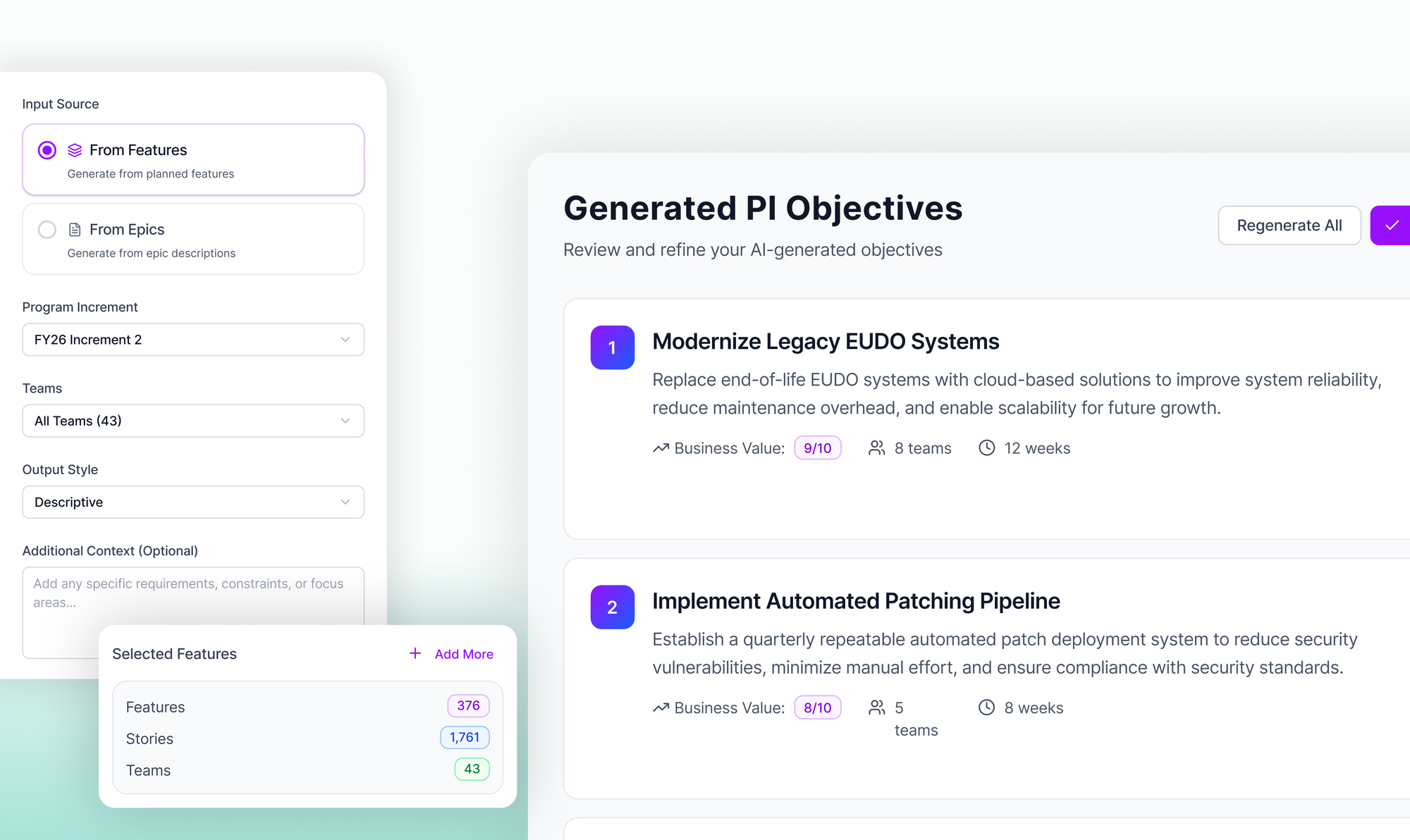
2) Turn planning into a set of outcome hypotheses, not a list of commitments
In outcome-based delivery, every major initiative is a hypothesis.
AI can help sharpen the hypothesis by using historical data:
- Similar initiatives in the past
- Typical leading indicators
- Time-to-impact patterns
- Risk profiles that correlate with outcome failure
It does not decide your strategy. It stops you from pretending your strategy is certain.
3) Make measurement realistic instead of heroic
Most teams do not measure outcomes because it requires manual effort and cross-system coordination. People need to pull dashboards from multiple OKR Software tools, argue about definitions, and then the meeting ends and everyone goes back to shipping.
AI can automate the boring parts:
- Summarize outcome progress in plain language
- Pull relevant signals into one view
- Flag anomalies and drift
- Identify where work is no longer aligned to stated objectives
In other words, it makes “prove it” a normal expectation, not a quarterly research project.
The shift leaders need to make: from managing delivery to managing value.
Agile leaders and executives often say they want outcomes, but they still operate the governance like it is 2009.
They ask for plans, not hypotheses. They ask for status, not evidence. They ask for outputs, not impact.
Here’s what changes when you take outcome-based delivery seriously:
You stop funding projects and start funding strategic planning.
Projects end. Themes persist.
A strategic theme like “Reduce onboarding friction” should live across quarters, across teams, across products, until the business outcomes move.
This is how you avoid the classic pattern:
- launch a program
- deliver a bunch of stuff
- declare victory
- nothing changes
- start a new program with a new name
Departments stop optimizing locally and start contributing deliberately.
Outcome-based delivery forces a harder conversation.
Marketing might want leads. Product might want adoption. Engineering might want platform resilience. Support might want fewer tickets. Compliance might want audit readiness.
Those can all be valid. But they must map to the same strategic themes and outcomes. Otherwise you get a company where every department is “winning” and the business is losing.
Teams stop inheriting the backlog and start owning the problem.
This is a big one.
Teams should not be handed a list of features. They should be handed an outcome target and a context.
Example: Instead of “Build feature X,” give them:
- Objective: Increase active usage of a key workflow by 15%
- Constraints: Must not increase support tickets
- Time window: 8 weeks
- Leading indicators: Activation rate, task completion, drop-off points
Then let teams propose the moves, test them, measure results, adjust.
That is actual agility.
What this looks like in practice: one flow, all the way down.
Here’s a practical blueprint you can use without needing a consulting firm and three months of workshops.
Step 1: Define 3–6 strategic themes
If you have more than six, you don’t have strategy. You have a wish list.
Examples:
- Increase retention in core customer segment
- Reduce cost-to-serve
- Improve delivery predictability
- Strengthen security and compliance posture
- Expand into a new market
Step 2: Attach measurable outcomes to each theme
Not activities. Not “launch program.” Outcomes.
Examples:
- Reduce churn from 8% to 6%
- Cut onboarding time from 10 days to 3
- Improve on-time delivery from 55% to 75%
- Reduce Sev-1 incidents by 40%
- Pass audit with zero high-risk findings
Step 3: Break outcomes into department-level objectives
Each department can now contribute without inventing its own universe.
Example theme: Reduce onboarding friction
- Product: improve activation rate
- Engineering: reduce latency and failure points
- Support: reduce onboarding-related tickets
- Sales/CS: shorten time-to-value
Step 4: Translate objectives into a small set of initiatives
This is where you choose the bets.
And you should kill more bets than you fund.
Step 5: Drive work as measurable actions tied to objectives
Now your backlog stops being a graveyard and becomes a portfolio of experiments and deliveries tied to outcomes.
AI can help keep this honest by continuously checking:
- Is the work still aligned?
- Are we seeing leading indicators?
- Are we drifting into scope without impact?
- Where are the risks, and what is their likely effect on outcome delivery?
A direct message to C-suite and Agile leaders
If you keep rewarding output, you will keep getting output. Lots of it. Delivered on time. Beautifully presented. Completely disconnected from business impact.
If you want outcome-based delivery, you need to change what you ask for and what you tolerate.
Ask:
- “Which strategic theme does this support?”
- “What outcome are we targeting?”
- “What evidence will show progress in the next 30 days?”
- “What are we stopping so this can succeed?”
- “What did we learn from the last increment?”
And then act on the answers.
Because the most expensive thing you can do in a modern organization is ship the wrong thing faster.
The provocative conclusion: AI will not save your delivery. Evidence will.
AI is not the point. Outcomes are.
AI just removes the excuses.
It makes it harder to hide behind activity, and easier to run delivery like a system that learns.
So here’s the challenge: Stop celebrating shipping. Start demanding proof.
Because in the age of AI, output is cheap. Impact is the only thing that still costs something.
And it is the only thing worth paying for.