Memory Is the Whole Game: How Kendis’ Charlie AI Reads the Context Other Tools Miss
An executive-level conversation with Justin Oke, VP of Global Sales and Partnerships, on why physical sticky-note boards failed remote-first teams, the context that vanishes between one increment and the next, and how AI that actually remembers your programme turns task tracking back into strategic business speed.
The Conduit Paradigm: Why Charlie AI is the Missing Translation Layer Between Jira/ADO and SAFe
In a modern enterprise engineering ecosystem, frameworks like the Scaled Agile Framework (SAFe) provide excellent role clarity and structural guidelines for coordination. However, a glaring operational paradox emerges when these legacy processes are forced into distributed corporate environments. Traditional Application Lifecycle Management platforms, such as Jira and Azure DevOps (ADO), are fundamentally engineered to capture day-to-day transaction records, localized task lists, and highly customized ticket configurations. They excel at transactional execution but completely lack the macro-level contextual awareness needed to automatically track a holistic framework strategy.
Talisa (Interviewer): "When you look at the traditional friction points in scaled agile delivery, what was the core vision that drove the creation and introduction of Charlie AI?"
Justin: "SAFe is great. As a framework, it works incredibly well, especially for PI planning. It gives people specific roles—when you hire someone with that credential, you know exactly what they're capable of. It defines how a two-to-three-day PI planning session should run down to the minute. But the real gap is in the tooling. While Scaled Agile is fantastic in person with physical post-it notes and red yarn on the walls, most of the world now works remotely.
Teams are spread across time zones, and flying everyone to a single location every quarter is prohibitively expensive. And here’s the part people skip over: neither SAFe nor the ALM tools were ever designed for remote facilitation. SAFe assumes a room full of people with sticky notes. Jira and ADO assume someone at a desk updating tasks. Nobody built for a distributed team running a live planning event across time zones — that’s the gap. Kendis was built for that reality, and Charlie sits on top of it"
"Jira and Azure DevOps are excellent for daily task customization, but they aren't configured in the context of a scaling framework. Charlie AI was designed to be that essential conduit. It doesn't replace these ALM tools; it complements them by interpreting daily transactional engineering data and translating it directly into the context of SAFe. We wanted to make those hidden workarounds and dependencies instantly visible to the teams and leadership."
Talisa: "There is often a tension between automated intelligence and human intuition. How should delivery teams and AI work together without letting technology override human intuition?"
Justin: AI can easily produce a lot of drivel and feel quite fluffy if you don't constrain it. If you give it minimal context and expect a detailed, tailored response, you'll be disappointed. The magic is in the engine. It’s not just sending your text over to an LLM; the engine retains a form of localized memory—how you communicate, your role, your metrics, and your historical dashboards.
AI needs context. And the more context that you give it, then of course, the more precise the response is going to be.
For Charlie AI, that context means extracting team capacity, active risks, objectives, and sprint plans directly from Kendis, bundling them together, and sending that comprehensive package to the LLM. That’s how you get precise, relevant responses that match human intuition, rather than generic fluff. And we do this with strict data privacy guidelines; we don't capture personal data or let the public models train on your secure corporate IP
The Honest Question
Why not just plug an AI into Jira?
There’s a fair question coming for every tool like ours: if AI is this good, why not just plug Claude or another model straight into Jira and ask it for your summaries and reports? Here’s the honest answer — memory. A general AI pointed at Jira sees today’s tickets and nothing else. It doesn’t know your teams, your last three increments, the risks you carried forward, the objectives you set in planning, or how your RTE actually thinks.
Charlie isn’t a model bolted onto a board. It’s the model plus the context Kendis has been holding all along — your capacity, your risks, your objectives, your history. That’s the part a generic AI can’t replicate, because the context simply isn’t there to read.
Anyone can connect an AI to a task list. The difference is whether it remembers your programme.
PILLAR 2: REDEFINING THE PLANNING CYCLE
Eliminating Planning Fatigue: Deploying Charlie AI to Auto-Synthesize High-Value PI Objectives
Let’s be completely honest about large-scale alignment cycles: they are exhausting. Engineering teams frequently struggle with a deep cultural disconnect during these events. Software developers are at their absolute best when they are focused on writing clean code and solving complex technical problems at their workstations. Forcing them to step away from active development to spend hours translating technical features into abstract corporate goals is a highly unnatural thinking process.
Talisa: "Big room planning events are historically chaotic and heavy on administrative overhead. How does leveraging Charlie AI fundamentally transform the energy and focus of teams during these critical alignment cycles?"
Justin: This is where I might get a little controversial. Picture a developer who just wants to be at their desk writing clean code — and instead they’re in a planning room for days, sometimes a couple of weeks at the larger places. By the end, they’re translating technical work into business objectives, which is a genuinely unnatural thing to ask an engineer to do. That’s the friction Charlie is built to take off their plate."
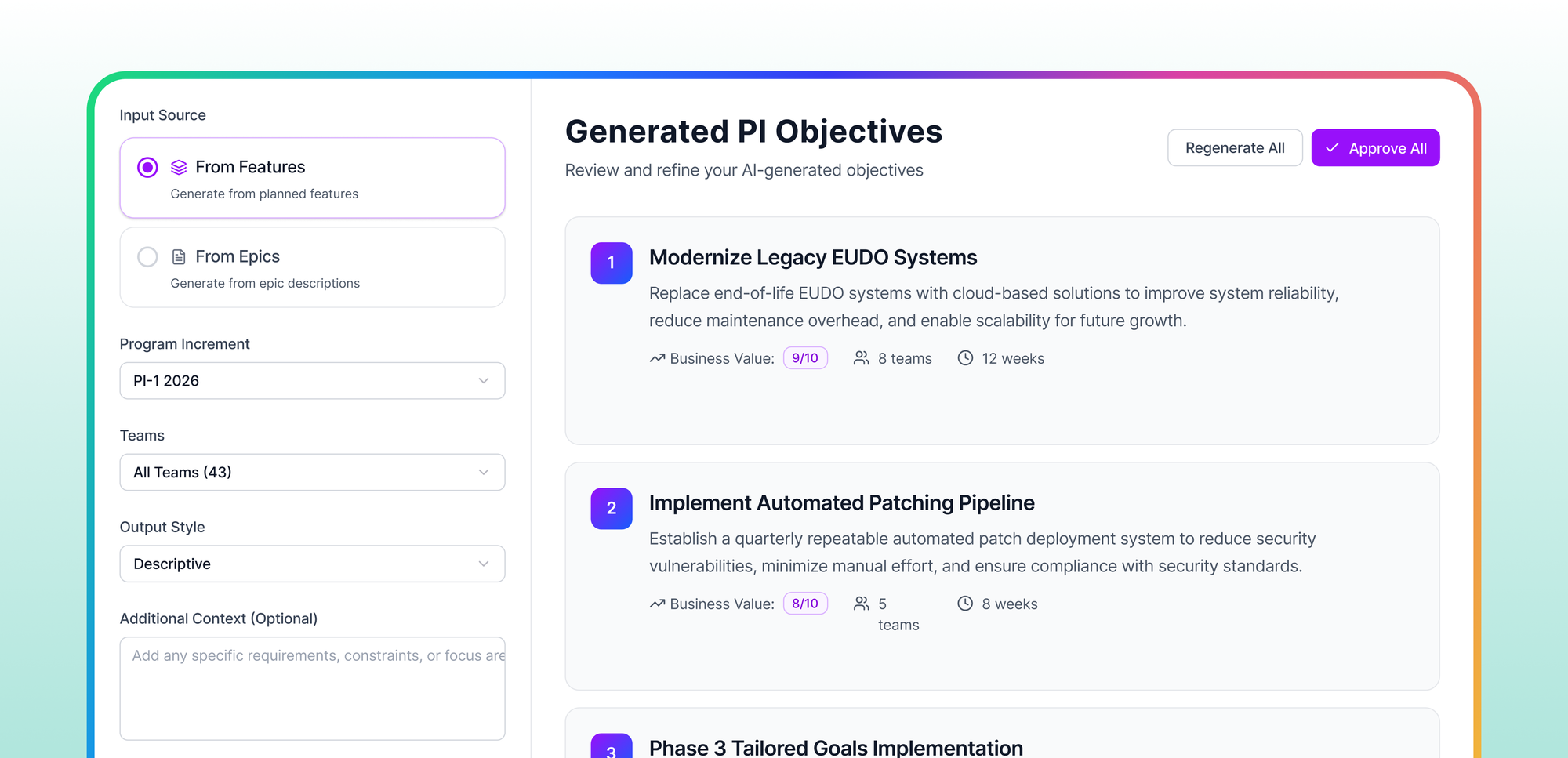
The standard output of planning is the 'PI Objective.' Developers are excellent at writing technical user stories using the classic 'as a user, I want...' format. But when you ask them to translate that work into abstract, business-facing objectives with mapped value points, it's a real head-scratcher. It’s an unnatural thinking process for most technical folks.
With Charlie AI, developers continue focusing on what they excel at—technical backlog descriptions. Charlie then reads those descriptions, analyzes the dependency links, and automatically crafts clear, business-ready objectives. The developers are relieved of the translation pressure, while product management and Release Train Engineers (RTEs) get high-quality, readable objectives instead of the meaningless six-word summaries developers often make up just to check a box.
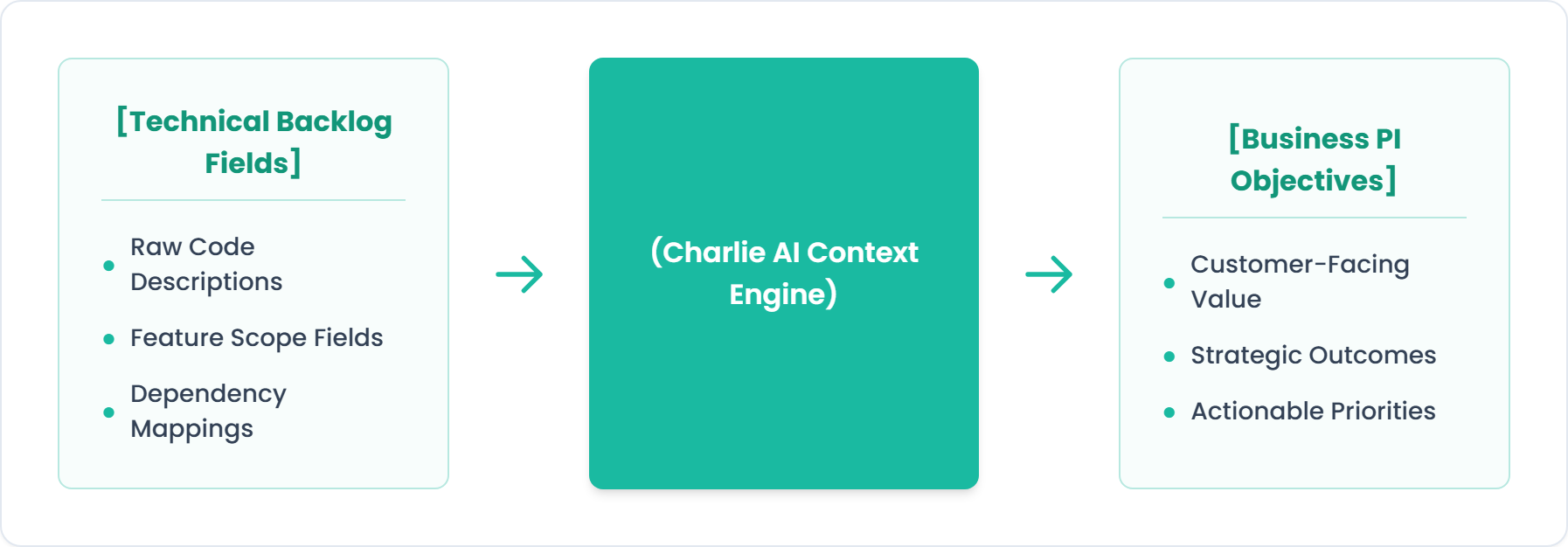
By standardizing this workflow, the platform helps your teams upskill for the AI era by offloading administrative tasks and letting engineers focus on what they do best. Release Train Engineers (RTEs) and Product Owners are the clear winners here. Instead of chasing down developers for updates, they instantly receive clear, outcome-focused milestones that align perfectly with business intent. This feature makes creating AI-powered PI objectives with Kendis AI a highly effective way to reclaim creative engineering hours.
PILLAR 3: STRATEGIC PORTFOLIO OVERSIGHT
From Data Silos to Executive Summaries: How Charlie AI Aggregates True Customer Value
For executive leadership, tracking progress across complex global portfolios is often an exercise in frustration. Traditional project reporting forces leaders to click through a maze of deep system sub-menus, isolated tracking fields, and flat burn-down charts just to evaluate milestone health. Even worse, standard metrics focus heavily on raw output velocity—such as counting completed features or total story points—which tells leaders absolutely nothing about actual progress.
Talisa: "Executives often struggle with a disconnect between high-level strategy and team-level execution. From a leadership perspective, how does Charlie AI help close this visibility gap?"
Justin: This is an area we are actively developing right now; it has not been publicly released yet. Today, if you want to track progress against milestones, you have to click through multiple screens, look at burn-downs, and analyze individual scope changes. It's a lot of manual configuration."
We are building the capability to type questions directly into Kendis. Soon, a leader can simply enter, 'What is happening with milestone XYZ?' and Charlie will instantly synthesize custom fields, story links, and issue logs from your ALM to deliver a conversational, context-aware progress report in seconds.
Talisa: "When managing complex portfolios, how can leaders utilize AI-generated business summaries to make faster, more proactive decisions?"
Justin: We've developed two core automated reports: the End of PI Planning Report and the End of Programme Increment Report. During the chaotic days of planning, someone has to explain to the financial decision-makers what was actually planned. Showing them a massive dependency board covered in tangled red string doesn't help.
Charlie AI reads your planned features, team capacities, risk structures, and objectives to compile an actionable executive overview. It tells leaders what actual value they are getting for their money, not just that 'we planned 300 features and 500 stories'—because honestly, nobody cares about raw issue counts. It even looks at delivery performance at the end of the increment, highlights what was achieved versus what slipped, and proactively recommends exactly which features to prioritize in the next cycle to close any outstanding gaps.
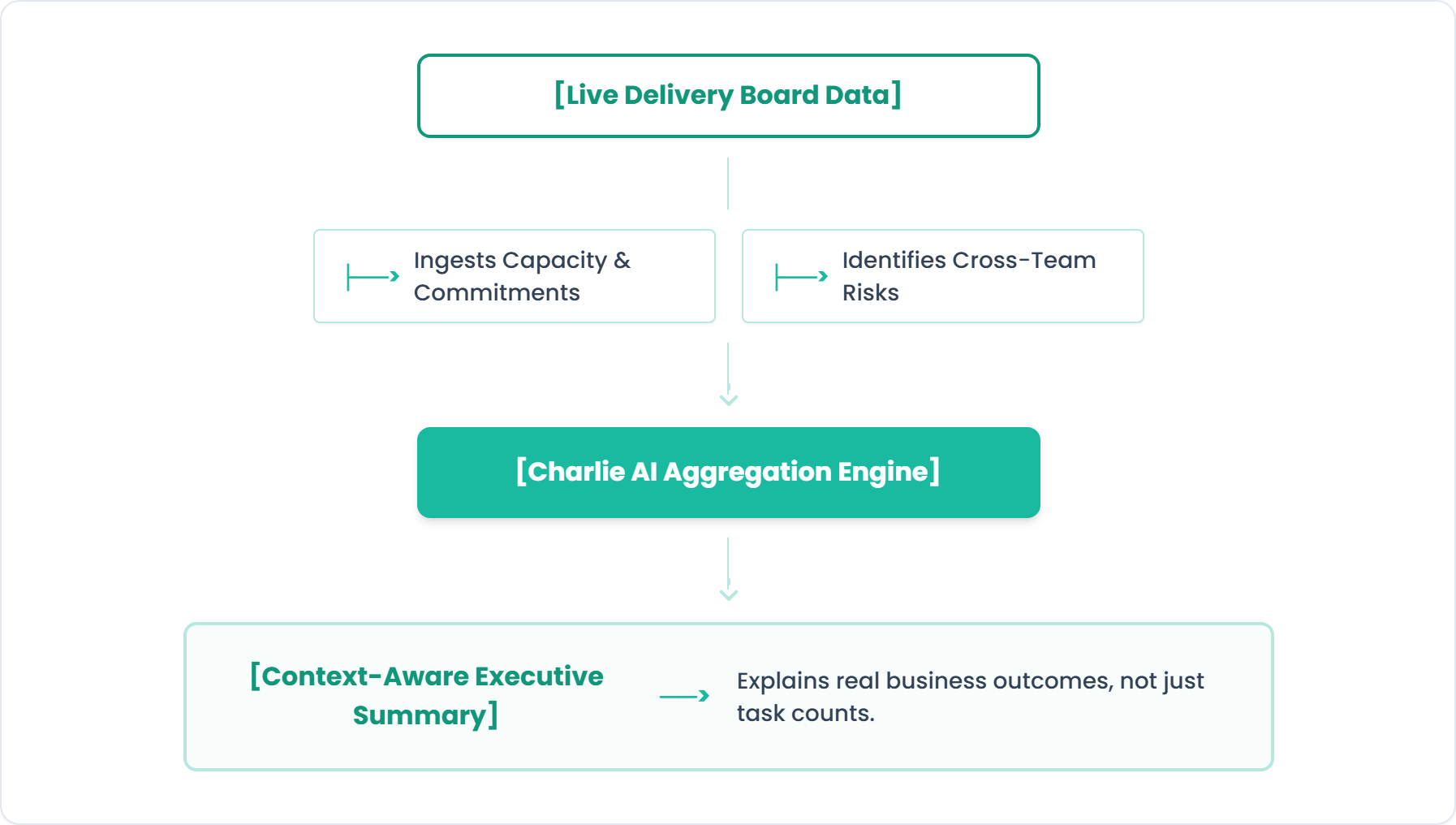
This ensures that AI in PI planning moves beyond simple text generation to deliver true, context-aware analysis. To learn more about how we integrate and support these cycles, you can review everything Kendis launched so far in 2026 on our product platform updates page.
Talisa: "For an enterprise to get the absolute most out of Charlie AI, what is the biggest cultural or operational shift the organization needs to embrace?"
Justin: The shift isn’t to stop using your ALM — Jira and ADO are exactly right for the daily task work, and teams update them every day because that’s where their sprint tasks live. But tasks are all they hold. The things portfolio leadership actually cares about — the risks, the objectives, the milestones, the increment as a whole — those don’t really live anywhere usable. That’s what Kendis provides: the framework layer on top of your tasks. And once those layers exist and you’re genuinely using them — logging the risks, mapping the dependencies, writing the objectives down — Charlie can consolidate them and tell the story they add up to. Not ‘we have 18 objectives and 7 risks,’ but ‘here’s what the portfolio is achieving, here’s what’s in the way, here’s where the value is.’ That’s the story portfolio management needs and almost never gets, because today it’s scattered across spreadsheets and slide decks."
"AI is only useful for companies like ours, if we have memory in there."
"Don't force a massive organizational restructure on day one. Start with simple, high-impact features. Automating objective synthesis is a perfect first step. Once the developers see how easily it simplifies planning overhead, you can build on that momentum across the entire portfolio.
THE CLOSING PERSPECTIVE
The Conversation We Should Be Having
As our interview wrapped up, Justin laughed about the nature of this discussion. "Honestly, Talisa, this is the conversation that we would have in a pub. If I was reading an agile blog, I would want to feel like I’m in that pub, having a real, authentic conversation with people who actually live this stuff."
Talisa: In just one sentence, how will the evolution of Charlie AI redefine how we and our clients approach business agility?
Justin: The evolution of Charlie AI will radically shorten the systemic gap between core business strategy and tactical agile execution teams by seamlessly translating technical implementation into true, business-measurable value.