If Nothing Changes After Inspect & Adapt, Stop Calling It Inspect & Adapt

Inspect & Adapt is supposed to be one of the most powerful tools in Agile delivery. Its purpose is simple: look at what happened during the last Program Increment (PI), understand why things went well or poorly, and make concrete adjustments for the next cycle. When done properly, it creates predictable, continuous improvement.
Yet, in most organizations, Inspect & Adapt has become a ritual, not a mechanism for change.
Most teams are honest during Inspect & Adapt.
They raise real delivery problems: missed commitments, unstable scope, blocked dependencies, unrealistic timelines.
Where things break down is after the session.
Feedback begins to move upward through layers of reporting and discussion. As it travels, the language becomes softer, the urgency fades, and ownership becomes unclear. By the time the message reaches decision-makers, the original problem often looks abstract enough to postpone rather than fix.
This is why many Inspect & Adapt sessions feel productive in the moment but invisible in their impact.
How Inspect & Adapt is supposed to work
At its core, Inspect & Adapt has two goals:
- Inspection: Teams analyze what happened. Were commitments met? Did dependencies block delivery? Was scope managed effectively?
- Adaptation: Insights from inspection inform real decisions. Priorities shift, capacity is allocated, dependencies are resolved, and leadership aligns resources to address systemic issues.
Without both, you’re only identifying problems, not solving them.
Why it fails after the meeting
Most Inspect & Adapt sessions fail at the adaptation stage. Teams raise real, concrete issues:
- A dependency blocked several stories.
- A feature was over-scoped and delayed the PI.
- Commitments were unrealistic for the available capacity.
But the moment the feedback moves upward, subtle but critical changes occur:
Feedback dilution: What begins as a concrete operational problem becomes a softened summary. “Dependency blocked delivery” turns into “coordination opportunity.” “Over-commitment” becomes “capacity consideration.” The problem isn’t wrong—it’s just unrecognizable to decision-makers.
Rushed reflection: Many sessions are scheduled as a checkbox. Teams spend an hour identifying issues and leave with no time to analyze root causes or systemic patterns. Reflection isn’t protected, and insights never reach the level where decisions can be made.
Lack of ownership: Adaptation often defaults to “everyone’s responsibility.” When no one is explicitly accountable, improvements stall. No one is asked to implement changes, allocate resources, or follow through.
No funding or capacity: If fixing issues requires time, budget, or reprioritized work, but none of these are allocated, the conversation remains theoretical. Observation without resources rarely produces action.
Practical steps to make Inspect & Adapt work
Here’s how organizations can ensure the process produces real improvement:
1. Base conversations on evidence: Bring clear metrics to the session. Kendis visualizations provide concrete delivery data, dependency status, and completion metrics. Evidence removes ambiguity and makes discussions actionable.
2. Assign explicit ownership: Each adaptation item should have a named owner, a timeline, and allocated resources. Shared responsibility leads to inertia; clarity ensures follow-through.
3. Fund adaptation: Improvement requires time, capacity, or budget. Organizations must treat adaptation as a decision—not just a theme for discussion. Without funding or allocation, sessions produce ideas, not outcomes.
4. Leadership inspection: Teams inspect operational delivery, but leadership must inspect portfolio-level priorities, resourcing, and systemic blockers. Adaptation is meaningless if only execution is inspected while strategic constraints remain unexamined.
5. Track outcomes continuously: Follow through on commitments with reports and dashboards. Kendis provides visibility across sprints and PIs, ensuring adaptation remains alive and measurable.
Learn more about tracking through Kendis Dashboards
Turning evidence into action with Kendis
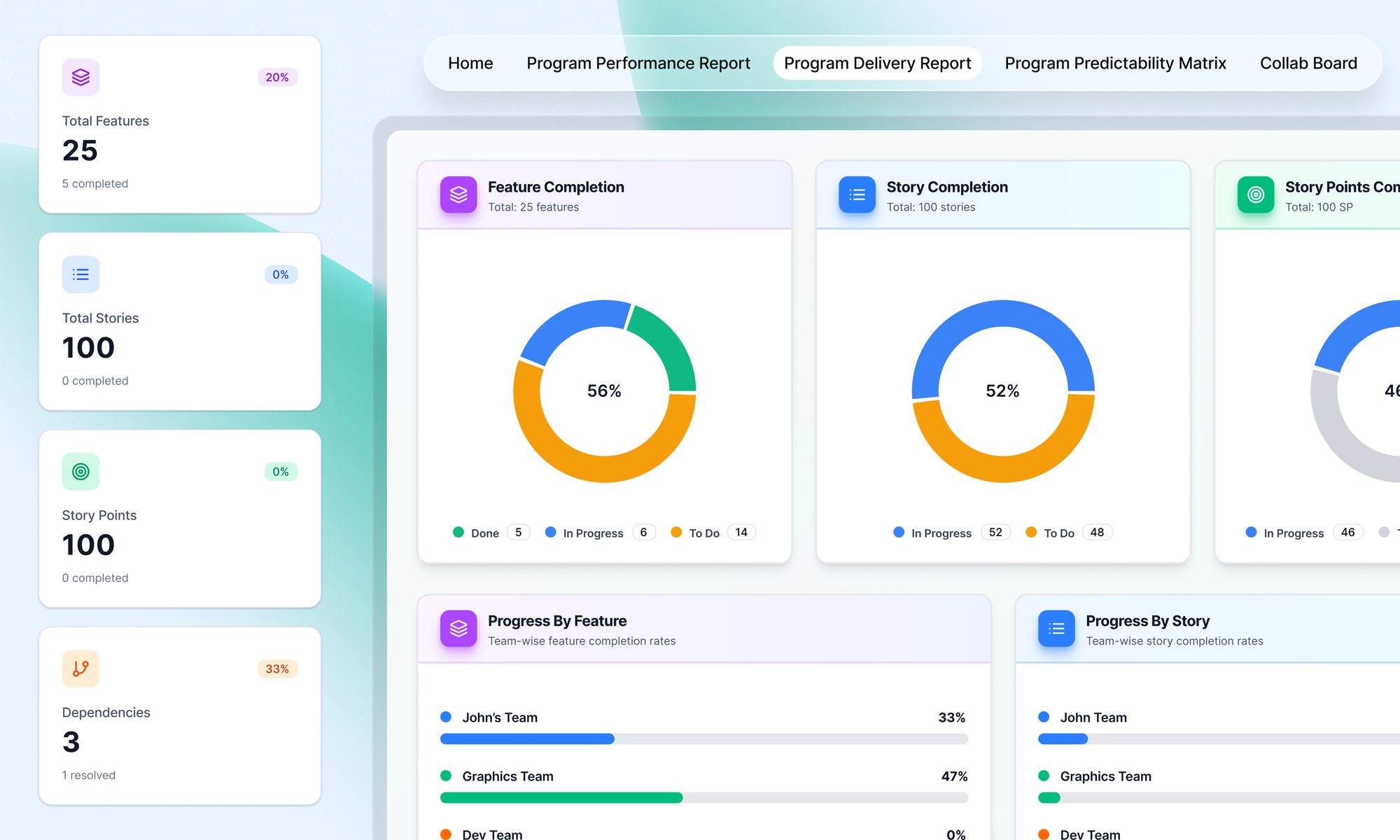
Kendis structures Inspect & Adapt around evidence and visibility, helping teams and leadership move from discussion to action.
PI Delivery View: Teams can see original commitments versus final delivery for each feature or story. Missed commitments, over-scoped items, and slipped priorities are immediately visible. This can also be viewed in comparison with previous PIs, allowing you to assess whether planning volume is increasing without a matching increase in completion. This removes guesswork and ensures inspection is grounded in fact.
Dependency Tracking: All dependencies are visible across teams, with status and ownership clearly displayed. When adaptation requires resolving blockers, Kendis makes it obvious who needs to act and what the impact is.
Program Performance Report: Tracks completion of objectives and contributions by team. Leadership sees whether PI outcomes met business objectives and can make informed funding or reprioritization decisions.
Program Delivery Report & Predictability Matrix:
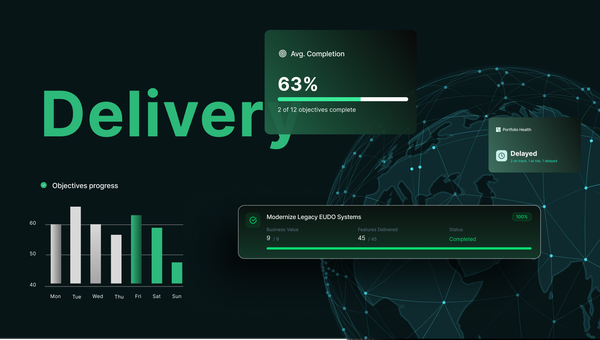
The Kendis Program Performance Report automatically pulls "Business Value" scores assigned during PI Planning. Kendis calculates your Program Predictability Measure instantly, showing which teams met their objectives and which faced hurdles.
But Inspect & Adapt should not rely on Business Value alone. True predictability comes from comparing this PI to previous PIs. Kendis allows you to see how this PI performed against the last one or two PIs — not just in Business Value, but in delivery patterns. You can compare how many Features were planned, how many were completed, and whether completion ratios are improving or declining over time. That comparison is what turns a score into insight.
Inspect & Adapt User Setup Guide
Bottom line
Inspection alone is easy. Adaptation is hard. Organizations that succeed treat adaptation as an explicit goal, assign ownership, allocate resources, and track outcomes. Without these, Inspect & Adapt is just a meeting with a name.
If nothing changes after your session, it’s time to stop calling it Inspect & Adapt and start building a system that actually does.