How Is AI Transforming Strategic Planning and Business Decision-Making

Imagine finalizing a portfolio plan for the quarter, only to discover halfway through that the world has moved on. By the time most strategic decisions are acted on, they’re already outdated. In complex portfolios, execution moves faster than interpretation, and leaders are always a quarter behind reality. This gap is what we call a strategic lag.
Traditional strategic planning approaches are often manual, static, and slow. Despite the abundance of data available today, organizations struggle to turn that data into actionable insight quickly enough. Strategy teams spend hours analyzing reports, tracking metrics, debating scenarios, and yet the picture they assemble is often still incomplete. By the time insights reach decision‑makers, the landscape has already shifted and opportunities may have slipped away.
In markets characterized by accelerating change, the ability to make bold bets early, and then pivot quickly as reality changes is more valuable than ever. This is precisely where AI for strategic planning becomes a game‑changer. By connecting strategic intent with real‑world execution, AI helps leaders make confident, timely decisions without losing sight of the bigger picture.
AI transforms strategic planning by continuously interpreting execution signals, linking strategic objectives to outcomes on the ground, and exposing risks or misalignments before they escalate. Instead of strategy being a historic review that happens after the fact, it becomes a living, adaptive system that keeps pace with the speed of execution.
How AI Transforms Strategic Planning
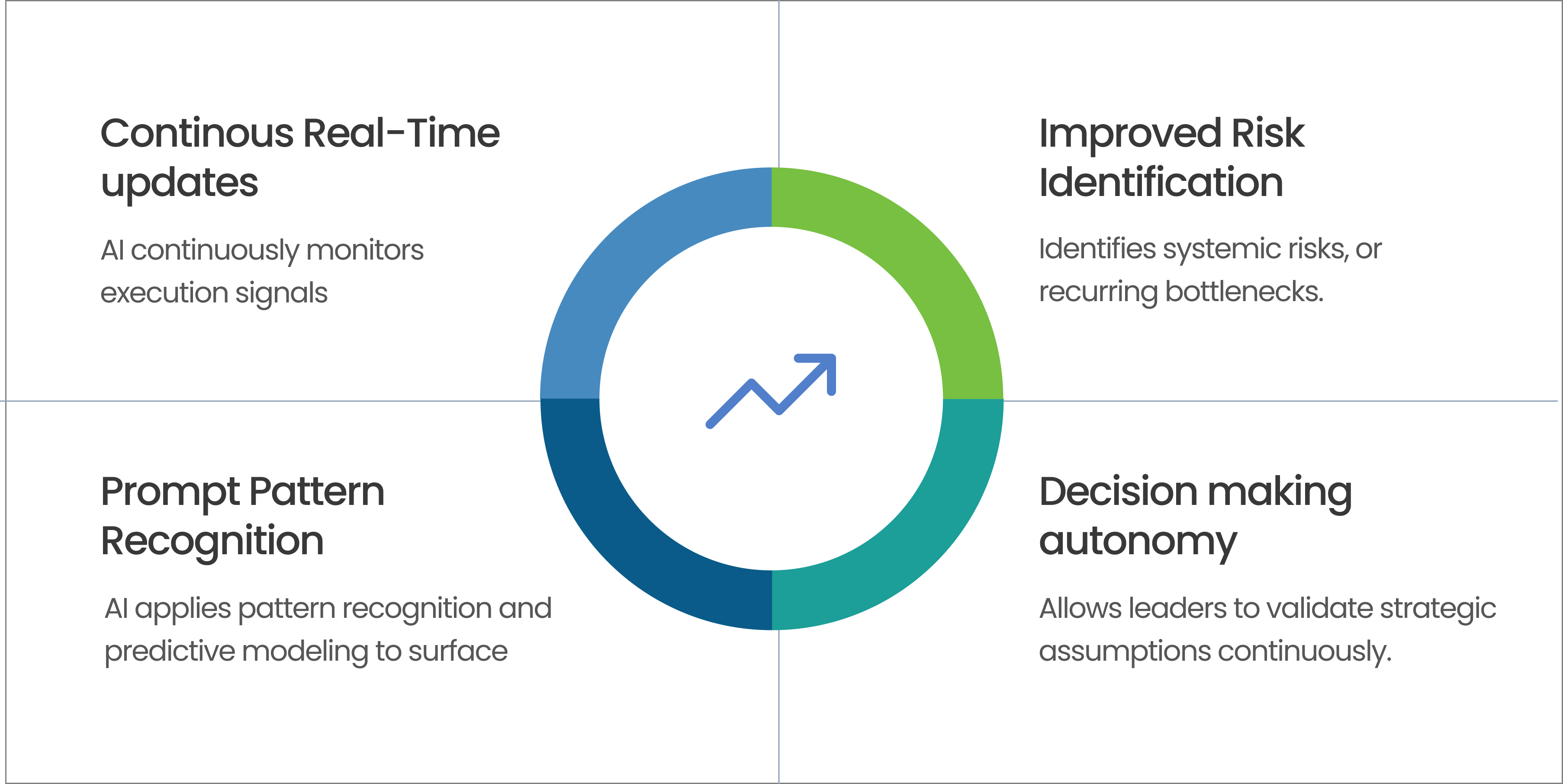
At the core of AI’s transformation of strategic planning is its ability to collapse strategic lag. Instead of relying on periodic reports, dashboards, and manual summaries, AI systems ingest and interpret delivery data as it flows through the organization. This continuous interpretation enables leadership to respond to reality — not the version of reality that existed weeks or quarters ago. AI also changes the strategic planning experience itself. It does not just report; it prompts. By surfacing patterns, trade-offs, and potential blind spots, AI helps leadership teams ask better questions earlier and with more confidence. You are no longer carrying the full cognitive load of strategic themes alone. Instead of one person trying to connect every dependency, risk, and outcome signal manually, AI provides a thinking partner that keeps critical context visible and turns strategy into an active, ongoing conversation.
Continuous Monitoring of Execution Signals
AI continuously monitors execution signals by integrating with task boards, project management tools, workflow systems, sprint trackers, and other delivery platforms. These systems generate real‑time data on progress, dependencies, bottlenecks, and throughput. AI doesn’t just collect this data — it interprets it.
Rather than waiting for weekly updates or quarterly reviews, leaders can get a near real‑time picture of what teams are delivering, where work is diverging from plan, and which dependencies are creating risk. This shift from periodic snapshots to continuous visibility significantly reduces the distance between the work teams are doing and what leadership understands about that work.
In research on digital transformation, the MIT Center for Information Systems Research (CISR) finds that organizations that manage key processes in real time — with direct access to operational data — show notable advantages in responsiveness, coordination, and performance outcomes compared with peers that rely on delayed reporting.
Pattern Recognition and Risk Identification
Once data is collected, AI applies pattern recognition and predictive modeling to surface insights that humans alone would miss. Machine learning models can analyze historical and current performance patterns to identify systemic risks, creeping misalignment, or recurring bottlenecks.
For example:
- If multiple teams repeatedly miss dependent milestones, AI can infer a broader risk to feature delivery and alert leadership sooner.
- If changes in customer feedback start correlating with shifts in work priorities, AI can highlight which initiatives may be diverging from strategic intent.
These capabilities are not hypothetical. Organizations using advanced analytics alongside AI have shown measurable improvements in operational forecasting accuracy and risk mitigation effectiveness because they detect patterns that are invisible to manual review.
Linking Strategy to Execution
The traditional missing link in strategic planning has always been connecting high‑level goals to what teams are actually delivering. AI bridges this gap by aligning strategic themes and objectives directly to delivery outcomes.
Instead of interpreting progress from high‑level summaries like the planned output of Portfolio A for Q2 is 60% complete AI maps objectives to the actual results being produced, such as features delivered, customer value unlocked, or risks mitigated. This direct mapping allows leaders to validate strategic assumptions continuously.
When execution signals show misalignment with strategic intent, AI can highlight this early — enabling leaders to adjust priorities, reallocate resources, or rethink strategic bets before momentum is lost.
AI doesn’t replace human judgment — it enriches it with timely, actionable evidence.
Making Strategic Themes and OKRs Real
Strategic themes and portfolio OKRs are intended to anchor direction across time, departments and teams. But in practice, progress against these objectives is often inferred from fragmented updates rather than observed directly. By the time misalignment is noticed, the window for course correction may already be closing.
AI fundamentally changes this dynamic.
Objectives as Living Indicators
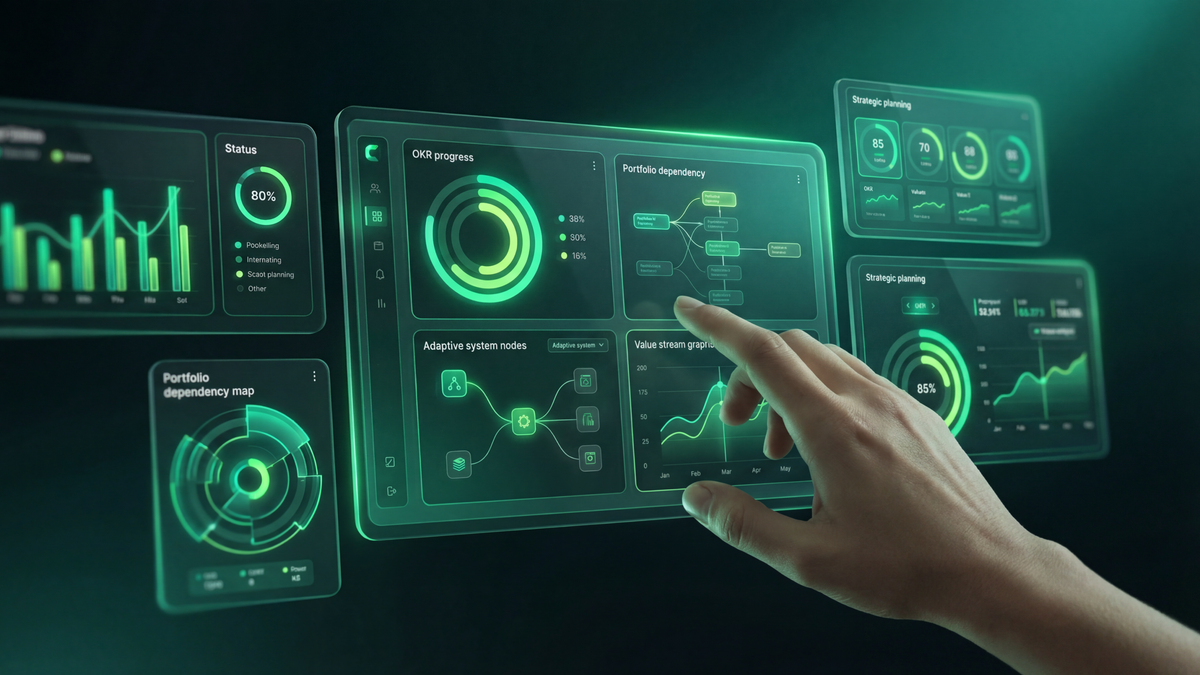
With AI, strategic themes and OKRs become living indicators — not static milestones revisited quarterly. As teams deliver work, AI connects outcomes to objectives in real time. Leaders can immediately see whether work is advancing strategic priorities, where gaps are emerging, and which risks need attention.
This is more than convenience — it changes the role of objectives from post‑hoc performance labels into actionable steering tools.
Grounded Decision‑Making with AI Insight
One of the most significant impacts of AI in strategic planning is how it changes decision‑making. In traditional models, leaders make decisions based on periodic summaries, intuition shaped by conversations and reports, and lagging indicators. This leaves a gap between intention and reality — a gap AI helps close.
Operationalizing AI for Strategy with Kendis
The principles above are powerful in theory, but what do they look like in practice?
Kendis puts this vision into action by embedding AI directly into the planning and tracking workflow. It connects portfolio‑level strategic themes to individual and team‑level work in a way that turns abstract strategy into a living system of execution.
Here’s how Kendis operationalizes AI‑assisted strategic planning:
1. Continuous Progress Visualization
Leaders and stakeholders can see progress across teams and programs without manual consolidation. AI synthesizes delivery data so that leadership always has visibility into what’s happening now, not weeks ago.
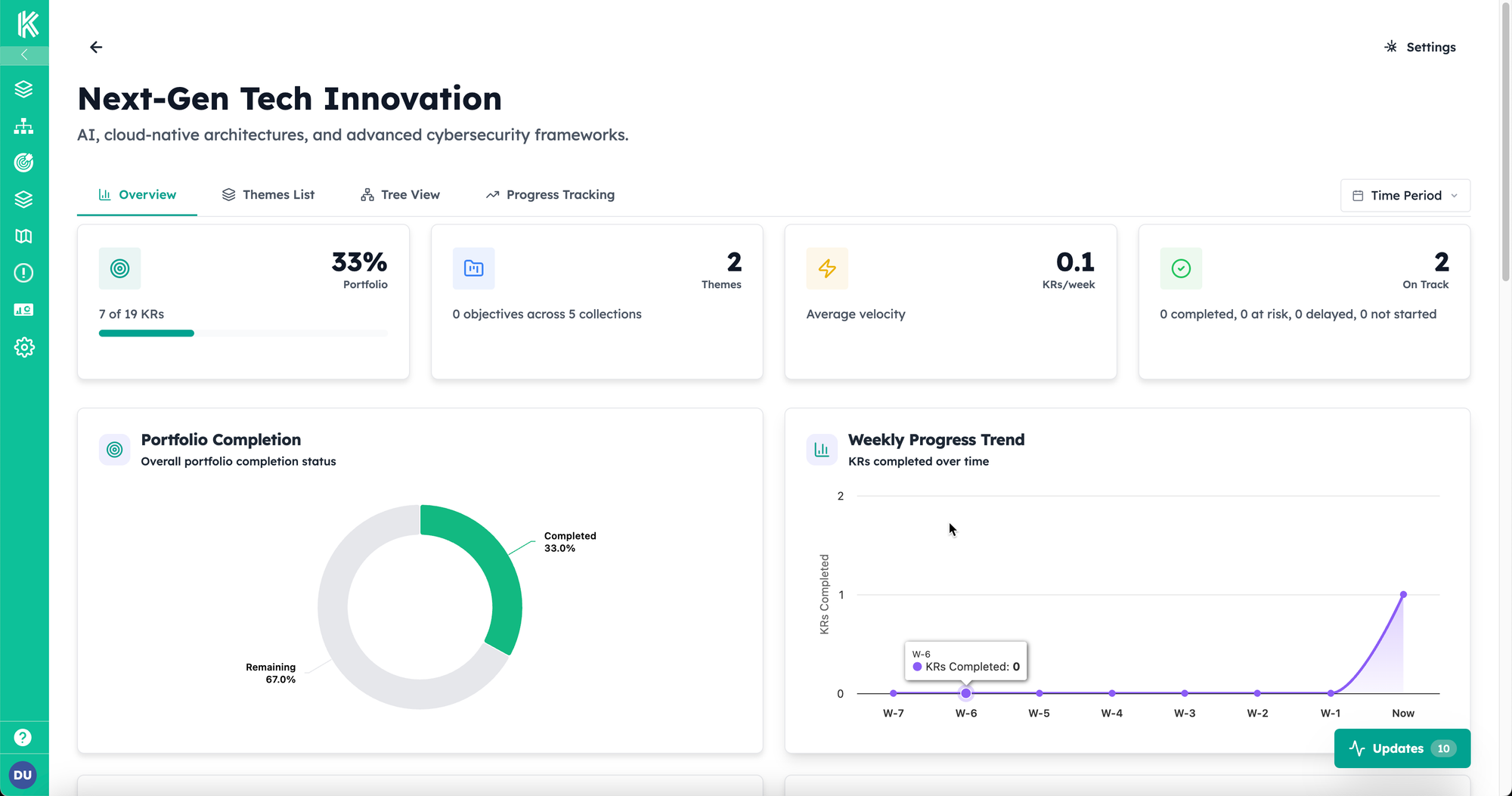
2. Early Detection of Emerging Risks
AI models detect patterns that indicate misalignment or risk before they escalate. Rather than waiting for lagging indicators, Kendis highlights where dependencies are strained, where delivery trends deviate from expectations, and where strategic themes are under pressure.
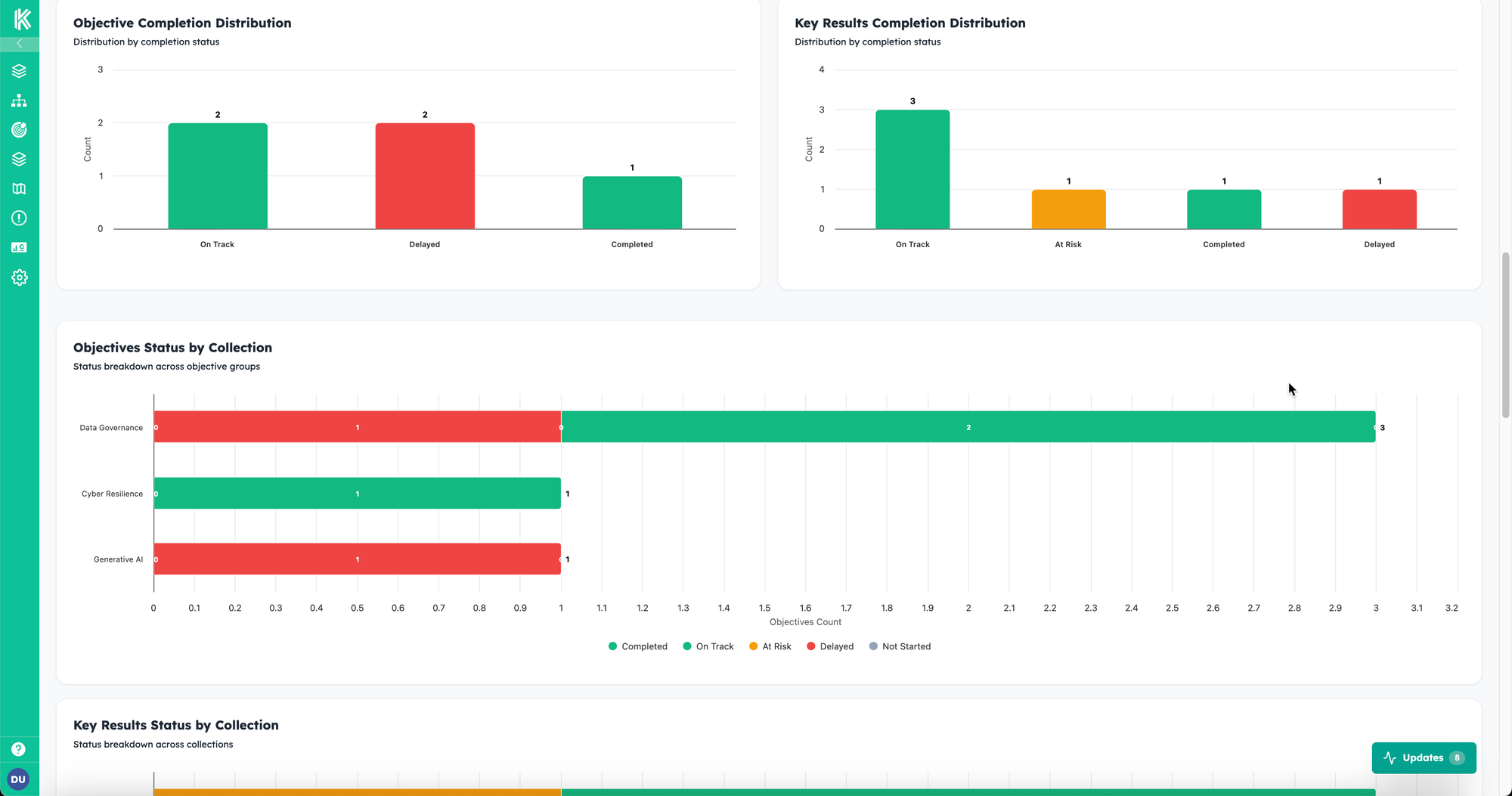
3. Reduced Manual Reporting Effort
Teams no longer have to spend hours preparing reports and reconciling updates. Kendis automatically ingests data from systems already in use, reducing manual aggregation and freeing teams to focus on delivery.
4. Real‑Time Linking of Objectives to Outcomes
Strategic intent becomes visible through delivery outcomes. Kendis maps objectives directly to execution signals, showing whether work is advancing themes and where adjustments are needed.
By embedding AI into planning and tracking, Kendis ensures that strategy is adaptive and continuously connected to reality — not a static annual exercise, but a living capability that evolves with execution.